What the abdominal crunch does and who it is for
The seated abdominal crunch machine is the primary loaded core-flexion station found in Anytime Fitness, Jetts Fitness, Snap Fitness, and Plus Fitness. Many gym-goers perform endless sets of unweighted floor crunches or planks that stop stimulating muscular hypertrophy once they can easily complete 25 or 30 repetitions. Just like your chest, back, or quadriceps, the rectus abdominis is composed of fast- and slow-twitch skeletal muscle fibres that respond best to progressive mechanical tension in the 10 to 15 repetition range.
Mechanically, the machine guides your thoracic spine through controlled trunk flexion (drawing the bottom of your ribcage down toward your pelvis) against a selectorized weight stack while ankle rollers or foot pads stabilise your lower body.
In Gym.Coach, which supports 95% of commercial gym equipment across major and independent brands and selects 5 smartly coordinated stations every workout, the abdominal crunch works in direct partnership with the back extension machine to build a 360-degree muscular corset around your spine.
In Australian 24/7 key-fob clubs including Anytime Fitness Australia, Jetts Fitness, Snap Fitness AU, Fitness First AU, and Plus Fitness, this pin-loaded machine is typically from Matrix, Technogym, Life Fitness, or Gym80. Our Australian programme uses colour-coded adjustments so you can customise your seat position, align your joint centre, and stimulate deep muscle fibres while optimising strength in +2.5 kg increments (starting at 25 kg for men and 15 kg for women).
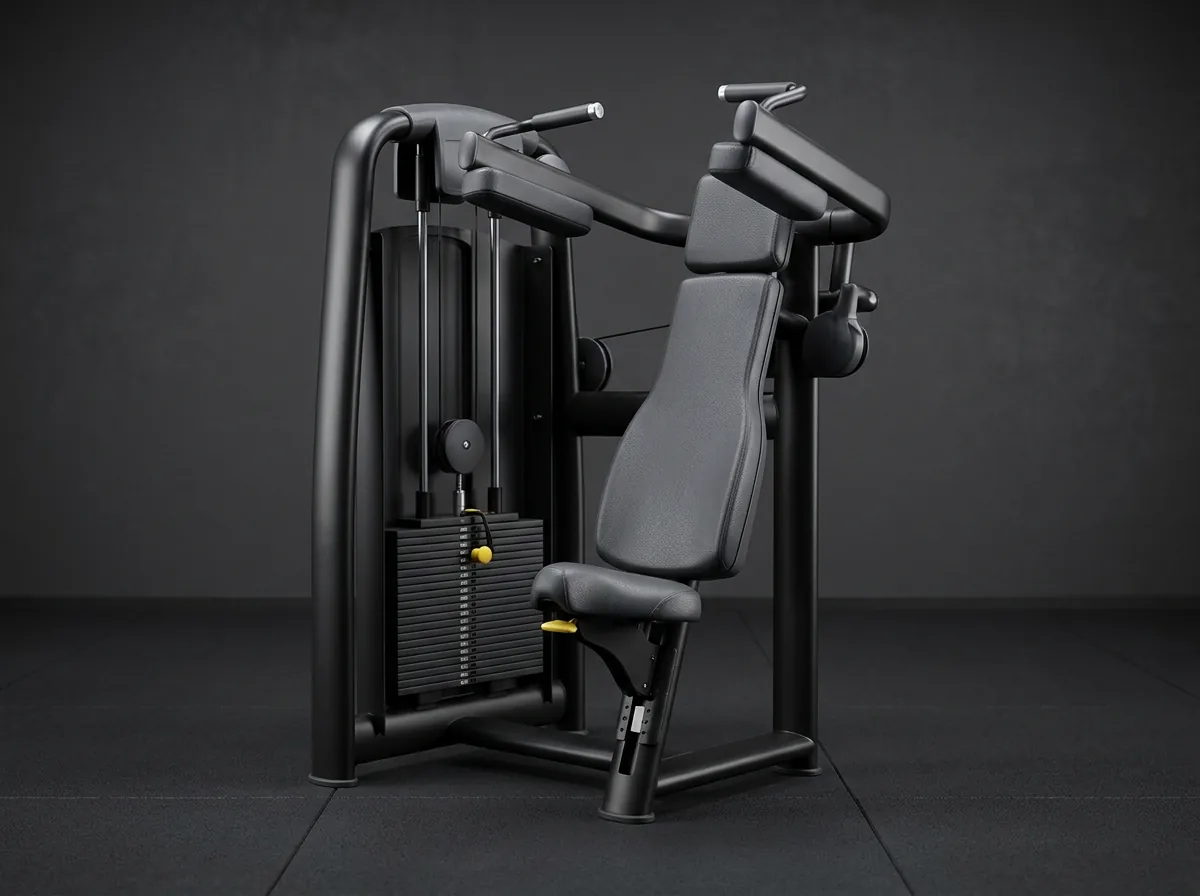
How do you set up the abdominal crunch in 20 seconds?
- 1. Align Your Mid-Torso (Lower Ribs) with the Machine Pivot Dot Adjust the seat height up or down until the circular mechanical pivot axis on the side of the machine frame lines up directly with the bottom of your sternum (just above your belly button), where your thoracic spine naturally flexes.
- 2. Select Your Starting Weight on the Stack Insert the selector pin at 25 kg for men or 15 kg for women. Starting with a moderate load prevents your deep hip flexors (iliopsoas) from taking over the movement.
- 3. Hook Your Feet or Shins Securely Behind the Lower Roller Pads Sit with your pelvis pressed all the way to the back of the seat cushion and place your feet on the footrests (or behind the ankle rollers if equipped). Relax your quadriceps and hip flexors rather than pulling hard with your legs.
- 4. Grasp the Overhead Handles or Brace Your Elbows Against the Pads Depending on your machine design, either hold the overhead handles alongside the sides of your head with your elbows bent and frozen in place, or cross your arms over the front chest bolster.
- 5. Set Your Pelvis Neutral and Inhale Before Crunching Rest your mid-back against the lumbar pad, keep your chin slightly tucked a fist-width from your chest, and take a preparatory breath into your belly before initiating the curl.
Save your seat height notch in Gym.Coach so the machine axis always aligns with your thoracic spine rather than your hips.
Execution: tempo, breathing, range of motion
- Concentric Phase: 1 Second Spinal Curl (Full Exhale) Exhale forcefully through pursed lips as you curl your upper spine forward and downward over 1 smooth second, thinking of folding your bottom ribs down toward your pubic bone rather than hinging flat at the waist.
- Isometric Peak Contraction: 1 Second Ab Squeeze Pause at the bottom of the crunch for 1 full second, blowing out the last 10% of air in your lungs to maximally contract the rectus abdominis and internal obliques.
- Eccentric Return Phase: 3 Seconds Controlled Uncurling (Inhale) Inhale steadily through your nose as you uncurl your spine vertebra by vertebra back to the upright starting position over a strict 3-second count. Stop 1 centimetre before the moving weight plate touches the stack.
Perform 3 working sets of 10 to 12 repetitions with a 90-second rest interval between sets. (1-1-3 tempo / 90s).
The 5 mistakes you see every day on the abdominal crunch
- 1. Hinging at the Hips with a Flat Back Folding forward at your hip joints while keeping your spine poker-straight trains the iliopsoas and rectus femoris (hip flexors) instead of your abdominals. Focus on rounding your upper back to bring your ribs toward your belt buckle.
- 2. Pulling Down with Your Arms and Biceps Yanking the overhead handles down toward your knees with your arms turns the exercise into an awkward pullover. Freeze your hands right next to your temples or collarbones and let your abs move your torso.
- 3. Holding Your Breath at the Bottom of the Crunch Keeping your lungs inflated with air blocks your ribcage from depressing fully and limits abdominal shortening. Exhale completely on every concentric curl so your ribs can close down.
- 4. Hyperextending Your Lower Back on the Return Letting the weight stack yank your torso into an exaggerated backward arch at the top strains the lumbar facet joints. Stop the eccentric return at a neutral upright posture.
- 5. Jerking the Weight with Neck Flexion Whipping your head and chin downward to launch a heavy stack stresses the cervical spine. Keep your neck locked in the same neutral curve as your upper back.
Which starting weight should you choose and how do you progress?
Beginners at Anytime Fitness or Jetts Fitness should start at 25 kg (men) or 15 kg (women). Use double progression: keep the weight fixed until you can perform 3 sets of 12 slow, breath-synchronized spinal curls with a 1-second bottom squeeze and a 3-second return, then add 2.5 kg or 5 kg. Over 12 weeks, average lifters progress to 37.5-45 kg (men) and 25-32.5 kg (women).
Double Progression Table (AU Metric KG):
| Session | Sets x Reps (1-1-3 Tempo) | Weight (KG) |
|---|---|---|
| Session 1 | 3x10 | 25 kg (F: 15 kg) |
| Session 2 | 3x11 | 25 kg (F: 15 kg) |
| Session 3 | 3x12 | 25 kg (F: 15 kg) |
| Session 4 | 3x10 | 27.5 kg (+2.5 kg step) |
If you feel the front of your hips burning more than your stomach, reduce the weight by one plate and focus on spinal rounding.
How does the abdominal crunch differ by brand?
| Machine Brand & Series | Seat & Pad Mechanism | Biomechanical Arc & Practical Note |
|---|---|---|
| Matrix Ultra / Versa Abdominal (common in Anytime Fitness and Snap Fitness) | Ratcheting seat post with overhead elbow pads and dual-position handles. | Dual-pivot linkage moves the seat pad slightly upward as your upper body crunches down, contracting upper and lower abs together. |
| Technogym Selection Pro / Artis Abdominal Crunch (common in Snap Fitness and Plus Fitness) | Seat-free or seated step-in frame with front-mounted shoulder/chest pads and dual grips. | Cam profile guides the shoulders along a tight circular spinal flexion path so the hip flexors stay relaxed. |
| Life Fitness Insignia / Signature / Insignia Abdominal (common in Jetts Fitness and Plus Fitness) | Pull-pin numbered seat post with over-the-shoulder harness handles and convex lumbar pad. | Convex back pad gently pre-stretches the rectus abdominis by 10 degrees at the top of each repetition. |
| Gym80 Sygnum (Fitness First AU, Doherty’s & performance 24/7 clubs) | Heavy-duty steel ratcheting seat pin with laser-etched position numbers | Direct mechanical cam profile; use the +2.5 kg micro-weight increment when progressing after 3x12. |
Frequently asked questions
Will using heavy weights on the abdominal crunch machine make my waist blocky or wide?
No. The rectus abdominis sits on the front of the abdominal wall and grows modestly in forward thickness (making abdominal definition more visible at normal body-fat levels) rather than widening your lateral waist.
Why does my lower back feel tired when I use the ab crunch machine?
Lower-back fatigue happens when you use a weight that is too heavy and pull with your psoas (deep hip flexor) muscles, which attach directly to the front of your lumbar vertebrae and tug your lower spine forward. Drop the weight by 5 kg (10 lbs) and curl your ribs down.
Can this machine burn belly fat directly off my stomach?
Spot reduction of fat in one specific body area is physiologically impossible; fat loss occurs systemically through a consistent nutritional energy deficit. However, progressive overload on the abdominal crunch machine thickens and strengthens the underlying abdominal muscle bellies.
How does Gym.Coach pair the abdominal crunch in my workouts?
Gym.Coach supports 95% of commercial strength equipment and builds every session around 5 smartly selected stations. It balances anterior core flexion on the abdominal crunch with posterior spinal extension on the back extension machine.