What the back extension does and who it is for
The seated back extension machine is the foundational posterior-spine strengthening station found in Anytime Fitness, Jetts Fitness, Snap Fitness, and Plus Fitness. Lower-back weakness and deconditioning are among the most common physical complaints in modern desk-bound life, yet many beginners avoid training their lower back out of fear of free-weight barbell deadlifts or awkward 45-degree Roman chair benches. The selectorized seated back extension lets you sit upright with a pelvic restraint pad or lap belt and strengthen your erector spinae and multifidus with controlled, quantifiable resistance.
Mechanically, pushing your upper back against the padded roller arm trains thoracic and lumbar extension along with controlled hip extension. Strengthening these deep paraspinal muscles builds structural resilience for lifting objects off the floor, standing for long periods, and maintaining upright posture.
In Gym.Coach, which supports 95% of commercial gym machines across major and independent brands and selects 5 smartly balanced stations every workout, the back extension provides the essential posterior core anchor to balance the abdominal crunch.
In Australian 24/7 key-fob clubs including Anytime Fitness Australia, Jetts Fitness, Snap Fitness AU, Fitness First AU, and Plus Fitness, this pin-loaded machine is typically from Matrix, Technogym, Life Fitness, or Gym80. Our Australian programme uses colour-coded adjustments so you can customise your seat position, align your joint centre, and stimulate deep muscle fibres while optimising strength in +2.5 kg increments (starting at 30 kg for men and 20 kg for women).
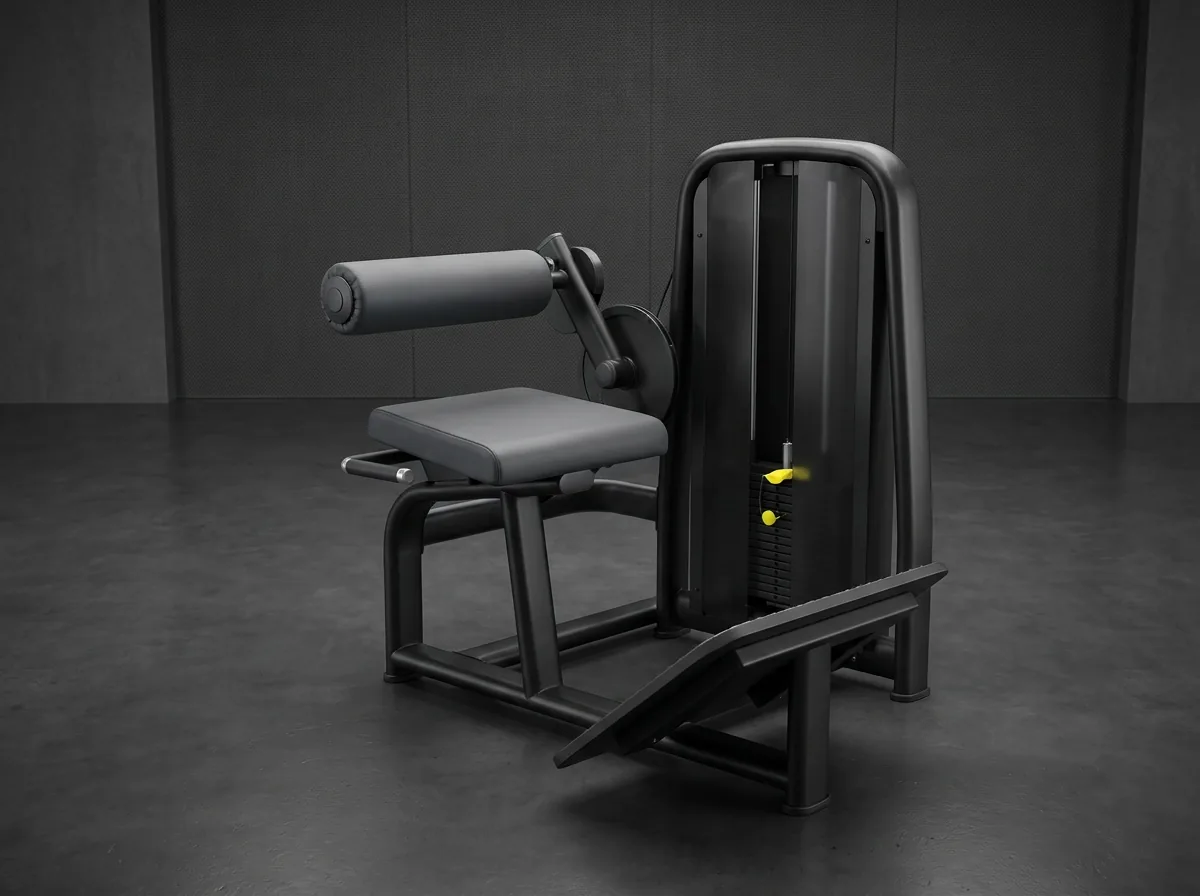
How do you set up the back extension in 20 seconds?
- 1. Position the Back Roller Pad Across Your Upper Shoulder Blades Adjust the roller arm or seat height so the cylindrical back roller rests squarely across your upper thoracic back (right across the meat of your shoulder blades, just below the base of your neck), never down in the curve of your lower back or high on your neck.
- 2. Align Your Hip Joint with the Machine Pivot Dot Sit all the way back into the seat crease so the outer bone of your hip (greater trochanter) lines up directly with the circular mechanical pivot indicator on the side of the machine frame.
- 3. Plant Your Feet on the Platform and Lock the Thigh/Pelvic Restraint Select 30 kg for men or 20 kg for women on the weight stack. Place both feet firmly against the angled footrest and tighten the lap seatbelt or padded thigh bolster snugly across your upper thighs so your pelvis cannot slide forward.
- 4. Set the Starting Forward-Flexion Angle Pull the range-limiter pin on the cam and set the starting position to a comfortable 30 to 45-degree forward lean so your lower back feels a gentle pre-stretch without collapsing over your thighs.
- 5. Cross Your Arms Over Your Chest or Hold the Side Grips Fold your arms X-style across your chest (or hold the side handles on the thigh bolster), brace your abdominal wall, and keep your chin neutral.
Log your footrest setting and starting angle number in Gym.Coach so your lumbar range stays consistent and safe.
Execution: tempo, breathing, range of motion
- Concentric Phase: 1 Second Extension Back (Exhale) Exhale forcefully and press your upper back smoothly backward against the roller pad over 1 controlled second until your torso is upright or reclined just 10 degrees past vertical in a natural straight line. Drive your heels into the footrest to keep your hips anchored.
- Isometric Peak Contraction: 1 Second Erector Hold Hold the extended upright position for 1 full second, feeling the firm muscular columns along either side of your spine contract evenly without overarching your lower back.
- Eccentric Return Phase: 3 Seconds Forward Return (Inhale) Inhale steadily through your nose while hinging forward under strict control over a 3-second count until you return to your starting angle. Reverse the movement 1 centimetre before the moving weight plate touches the rest of the stack.
Perform 3 working sets of 10 to 12 repetitions with a 90-second rest interval between sets. (1-1-3 tempo / 90s).
The 5 mistakes you see every day on the back extension
- 1. Hyperextending Far Past Vertical at the Back of the Rep Throwing your shoulders 35 or 40 degrees backward past vertical jams the lumbar spinous processes and facet joints together under load. Stop the backward push as soon as your spine reaches a tall, natural extension (about 10 degrees past vertical).
- 2. Leaving the Seatbelt or Thigh Pad Unfastened Without a tight pelvic restraint, pushing against the back roller simply slides your hips forward across the seat, turning the movement into a knee-extension push with your legs. Always lock your pelvis down first.
- 3. Setting the Roller Pad Too Low in the Mid-Back Placing the roller halfway down your spine shortens the lever arm and creates localized shear pressure on the thoracolumbar junction. Position the roller high across your shoulder blades.
- 4. Whipping Backward with Ballistic Momentum Jerking your head and shoulders backward to launch a heavy stack places sudden compressive forces on the lumbar intervertebral discs. Use a smooth 1-second press and a strict 3-second return.
- 5. Throwing the Head Back to Lead the Movement Looking up at the ceiling and pushing with the back of your skull strains the cervical spine. Keep your chin tucked slightly so your neck stays aligned with your thoracic spine.
Which starting weight should you choose and how do you progress?
Because the erector spinae and glutes work together to stabilise the trunk, beginners at Anytime Fitness or Jetts Fitness can start safely at 30 kg (men) or 20 kg (women). Use double progression: keep the weight constant until you complete 3 sets of 12 smooth, pain-free repetitions with a 1-second hold and a 3-second return, then add 2.5 kg or 5 kg. Over 12 weeks, average lifters reach 45-55 kg (men) and 30-37.5 kg (women).
Double Progression Table (AU Metric KG):
| Session | Sets x Reps (1-1-3 Tempo) | Weight (KG) |
|---|---|---|
| Session 1 | 3x10 | 30 kg (F: 20 kg) |
| Session 2 | 3x11 | 30 kg (F: 20 kg) |
| Session 3 | 3x12 | 30 kg (F: 20 kg) |
| Session 4 | 3x10 | 32.5 kg (+2.5 kg step) |
A healthy, muscularly warm pump along the two vertical columns of your lower back is completely normal; sharp joint pain is never the goal.
How does the back extension differ by brand?
| Machine Brand & Series | Pelvic Stabilization & Cam Setup | Mechanical Design & Practical Note |
|---|---|---|
| Matrix Ultra / Versa Back Extension (common in Anytime Fitness and Snap Fitness) | Multi-position starting angle pin, non-slip dual-level footrest, and heavy-duty retractable seatbelt. | Contoured lumbar seat pocket prevents your tailbone from sliding forward under heavy resistance. |
| Technogym Selection Pro / Artis Lower Back (common in Snap Fitness and Plus Fitness) | Yellow-flagged adjustable tibial/thigh stabilization pad paired with a wide self-pivoting upper-back roller. | Instead of a belt, Technogym uses a padded lower-leg and knee bolster that braces your femurs directly into the hip socket. |
| Life Fitness Insignia / Signature / Insignia Back Extension (common in Jetts Fitness and Plus Fitness) | 5-position cam range dial, ratcheting foot platform, and adjustable over-the-lap thigh restraint roller. | Counterbalanced roller arm ensures smooth resistance from the initial 45-degree flexed angle to upright extension. |
| Gym80 Sygnum (Fitness First AU, Doherty’s & performance 24/7 clubs) | Heavy-duty steel ratcheting seat pin with laser-etched position numbers | Direct mechanical cam profile; use the +2.5 kg micro-weight increment when progressing after 3x12. |
Frequently asked questions
How can I tell the difference between normal lower-back muscle soreness and bad back pain?
Normal muscular pump and delayed-onset muscle soreness (DOMS) feel like a symmetrical, dull tightness across the two fleshy muscle columns on the left and right sides of your spine. Sharp, shooting, or pinpoint pain directly on the central bony spine or radiating down a leg means you should stop immediately and check your range of motion.
Is the seated back extension machine safe if I have a history of mild lower-back stiffness?
Yes, when performed with a shortened range of motion and moderate weight. Set the starting cam pin to a conservative 20 to 30-degree forward lean and stop right at vertical so your spine moves through a gentle, supported mid-range arc.
Should I keep my back completely stiff or let it round slightly on the way forward?
Allow a small, controlled amount of natural thoracic and upper-lumbar flexion on the way forward while keeping your core lightly braced, then extend back to a tall neutral posture. Both isometric hip-hinge style and controlled spinal-extension style build strong paraspinal muscles.
How does Gym.Coach integrate the back extension into my training programme?
Gym.Coach supports 95% of commercial gym equipment across major and independent brands and selects 5 smartly balanced machines every workout. It alternates the back extension with lower-body and anterior core exercises so your lower back grows stronger without accumulating excessive fatigue.