What the bicep curl does and who it is for
The seated bicep curl machine (built around an angled preacher pad) is the dedicated elbow-flexion isolation station found in Anytime Fitness, Jetts Fitness, Snap Fitness, and Plus Fitness. When lifters perform standing dumbbell or barbell curls, it is easy to unconsciously swing the hips forward or drive the elbows ahead of the ribs to lift heavier weights. By resting the backs of your upper arms flat against an angled preacher cushion, the bicep curl machine prevents the shoulder joint from moving backward or forward, isolating 100% of the workload onto the biceps brachii, brachialis, and brachioradialis.
Mechanically, the cam-driven lever arm matches the strength curve of human elbow flexion: it keeps resistance smooth at the bottom when your elbows are extended and maintains productive tension through the midrange and peak contraction at the top.
In Gym.Coach, which supports 95% of commercial gym machines across major and independent brands and builds each workout around 5 balanced exercises, the seated bicep curl provides targeted upper-arm flexor work to complement compound pulling.
In Australian 24/7 key-fob clubs including Anytime Fitness Australia, Jetts Fitness, Snap Fitness AU, Fitness First AU, and Plus Fitness, this pin-loaded machine is typically from Matrix, Technogym, Life Fitness, or Gym80. Our Australian programme uses colour-coded adjustments so you can customise your seat position, align your joint centre, and stimulate deep muscle fibres while optimising strength in +2.5 kg increments (starting at 15 kg for men and 10 kg for women).
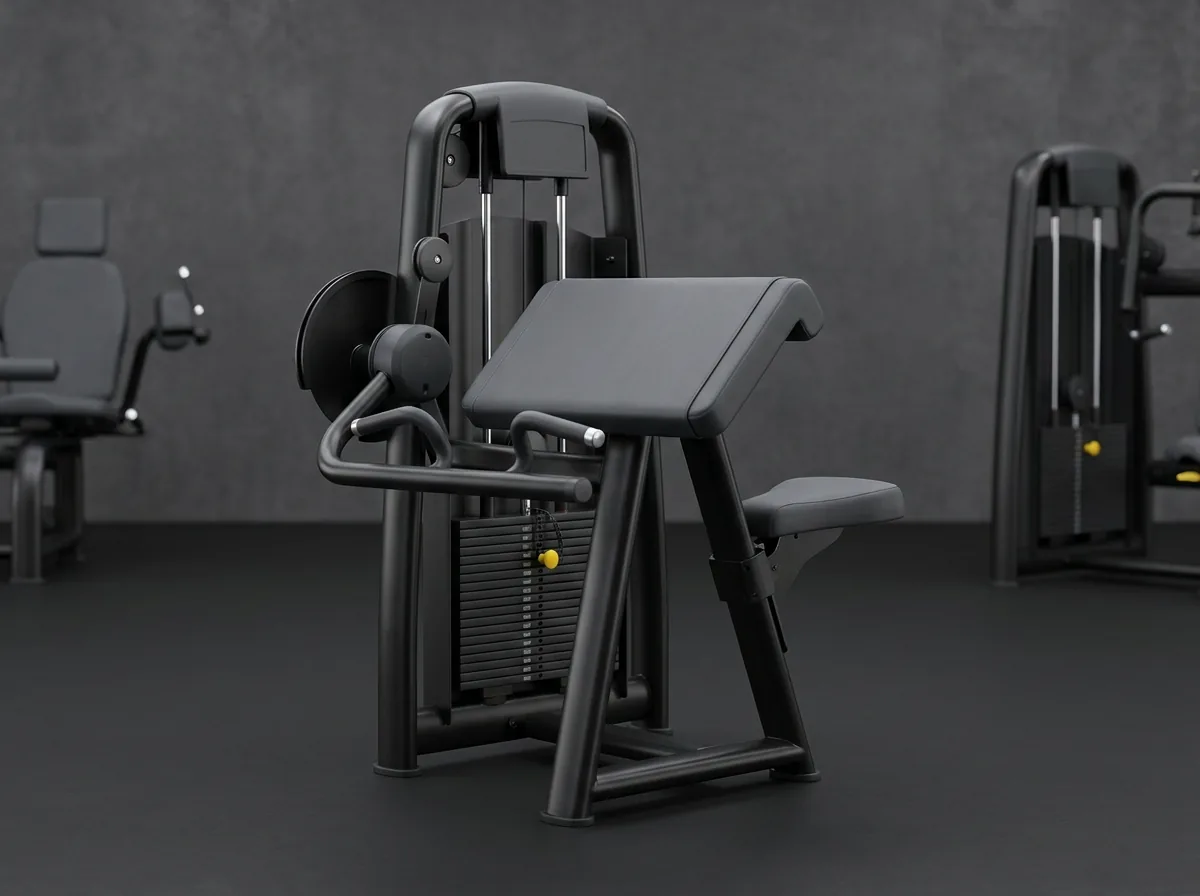
How do you set up the bicep curl in 20 seconds?
- 1. Adjust the Seat Height So Your Armpits Rest Snugly Over the Pad Top Pull the seat height pin and adjust the saddle until when you lean slightly forward, the top curved edge of the angled preacher pad fits cleanly into your armpits and the entire back of your upper arms (triceps) lies flat against the cushion.
- 2. Align Your Elbow Joints with the Machine Cam Pivot Slide your elbows down the pad until the bony crease of your elbow joint lines up directly with the circular mechanical pivot axis on the side of the lever arm.
- 3. Select Your Starting Weight on the Stack Insert the selector pin at 15 kg for men or 10 kg for women. Preacher-style machine curls are much stricter than standing dumbbell curls, so starting light ensures full range of motion.
- 4. Grasp the Rotating V-Handle with Supinated Palms Take hold of the revolving cambered handles with your palms facing upward (or slightly angled inward along the natural V-shape of the grip) and keep your elbows spaced directly at shoulder width.
- 5. Plant Your Feet and Lock Your Wrists Neutral Place both feet flat on the floor for base stability, drop your shoulders down away from your ears, and keep your wrists straight in line with your forearms rather than letting your hands flop backward.
Record your seat height notch in Gym.Coach so your elbows always match the cam pivot on repeat sessions.
Execution: tempo, breathing, range of motion
- Concentric Phase: 1 Second Curl (Exhale) Exhale forcefully and curl the handles upward toward your shoulders in a smooth 1-second arc while pressing the backs of your upper arms downward into the preacher pad.
- Isometric Peak Contraction: 1 Second Top Squeeze Pause at the top of the curl for 1 full second and squeeze your biceps hard while keeping your elbows glued to the upholstery.
- Eccentric Lowering Phase: 3 Seconds Lowering (Inhale) Inhale steadily through your nose while lowering the handles over a strict 3-second count until your arms are almost fully extended, stopping with a micro-bend (about 5 to 10 degrees) in the elbows and 1 centimetre before the weight plates touch.
Perform 3 working sets of 10 to 12 repetitions with a 90-second rest interval between sets. (1-1-3 tempo / 90s).
The 5 mistakes you see every day on the bicep curl
- 1. Lifting the Elbows Off the Preacher Pad at the Top Pulling your elbows up off the cushion at the end of the curl uses the anterior deltoids to lift the weight. Keep the entire back of your upper arm glued to the pad from bottom to top.
- 2. Standing Up Out of the Seat to Lean Over the Pad Rising off the saddle on the final reps lets you throw your upper-body weight backward to cheat the curl. Keep your glutes planted firmly on the seat.
- 3. Curling the Wrists Inward Toward Your Chin Flexing your wrists aggressively at the start of the rep overloads the medial epicondyle tendons (golfer's elbow) and reduces bicep recruitment. Keep your knuckles aligned straight with your forearm bones.
- 4. Dropping into a Dead Hyperextended Lockout at the Bottom Letting a heavy stack yank your elbows into a dead 180-degree hyperextension at the bottom of the preacher pad places extreme stress on the distal biceps tendon. Always reverse the rep with a 5-degree soft bend remaining.
- 5. Flaring the Elbows Wide While Gripping Narrow Setting your elbows wide apart on the pad while holding the inner handles twists the radioulnar and humeroulnar joints. Keep your elbows directly in line with your wrists.
Which starting weight should you choose and how do you progress?
Because the preacher pad removes all body English, beginners at Anytime Fitness or Jetts Fitness should start at 15 kg (men) or 10 kg (women). Use double progression: add 2.5 kg (or engage the 1.25 kg or 2.5 kg add-on plate) only after completing 3 sets of 12 full-range curls with a 3-second lowering phase and zero elbow lift. Over 12 weeks, average lifters reach 25-30 kg (men) and 15-20 kg (women).
Double Progression Table (AU Metric KG):
| Session | Sets x Reps (1-1-3 Tempo) | Weight (KG) |
|---|---|---|
| Session 1 | 3x10 | 15 kg (F: 10 kg) |
| Session 2 | 3x11 | 15 kg (F: 10 kg) |
| Session 3 | 3x12 | 15 kg (F: 10 kg) |
| Session 4 | 3x10 | 17.5 kg (+2.5 kg step) |
Always use the 1.25 kg or 2.5 kg add-on plate on single-joint arm machines so your form remains spotless.
How does the bicep curl differ by brand?
| Machine Brand & Series | Seat & Handle Configuration | Lever Design & Practical Note |
|---|---|---|
| Matrix Ultra / Versa Biceps Curl (common in Anytime Fitness and Snap Fitness) | Ratcheting seat column with angled preacher chest/arm pad and self-pivoting independent handles. | Independent arms let you curl both arms together or alternate left and right to eliminate side dominance. |
| Technogym Selection Pro / Artis Arm Curl (common in Snap Fitness and Plus Fitness) | Yellow pneumatic seat height adjuster plus a central self-adapting cambered bar linked to the cam. | Wait until seated with armpits snug over the top pad before pulling the central yoke into your starting curl. |
| Life Fitness Insignia / Signature / Insignia Biceps Curl (common in Jetts Fitness and Plus Fitness) | Pull-pin numbered seat post with rotating open-sided ergonomic grips. | Counterbalanced lever arm keeps starting resistance light at full stretch to protect the distal biceps tendon. |
| Gym80 Sygnum (Fitness First AU, Doherty’s & performance 24/7 clubs) | Heavy-duty steel ratcheting seat pin with laser-etched position numbers | Direct mechanical cam profile; use the +2.5 kg micro-weight increment when progressing after 3x12. |
Frequently asked questions
Why can I lift less weight on the bicep curl machine than with standing dumbbells?
Standing dumbbell curls allow subtle hip sway and forward elbow drift to help launch the weight out of the bottom. The preacher pad locks your humerus in place so your elbow flexors must lift 100% of the load through the hardest bottom angles.
Is it safe to straighten my arms all the way at the bottom?
Lower the handles until your arms are 95% straight, leaving a tiny 5 to 10-degree micro-bend in your elbows. That gives you a full stretch across the biceps and brachialis without putting excessive passive tension on the distal tendon.
Why do the insides of my elbows ache when I curl heavy?
Inner-elbow discomfort (medial epicondylitis) comes from gripping too tightly and flexing your wrists inward during the curl. Relax your finger grip slightly, keep your wrists flat in line with your forearms, and use the angled V-handle.
How does Gym.Coach schedule direct arm work?
Gym.Coach supports 95% of commercial gym equipment and selects 5 smartly coordinated machines every workout. It rotates direct arm stations like the bicep curl and tricep press alongside compound movements so your arms grow without overtraining your elbow tendons.