What the leg press does and who it is for
The seated horizontal leg press is the premier lower-body compound strength machine found across Anytime Fitness, Jetts Fitness, Snap Fitness, and Plus Fitness. While barbell back squats require coordinated thoracic extension, ankle dorsiflexion mobility, and lumbar stabilization all at once, the seated leg press supports your pelvis and spine against an angled backrest. That allows you to safely load the quadriceps, gluteus maximus, and adductors with high mechanical tension without your lower back becoming the limiting factor.
Mechanically, the exercise combines simultaneous knee extension and hip extension against a sled or moving footplate connected to a selectorized weight stack. Because your feet remain planted on a large non-slip platform, you can subtly shift emphasis between your quadriceps and your glutes simply by adjusting vertical foot height by a few inches.
Within Gym.Coach, which covers 95% of strength machines from major and boutique manufacturers and selects 5 balanced machines per workout, the leg press acts as the primary bilateral lower-body driver for bone density, metabolic demand, and lower-body strength progression.
In Australian 24/7 key-fob clubs including Anytime Fitness Australia, Jetts Fitness, Snap Fitness AU, Fitness First AU, and Plus Fitness, this pin-loaded machine is typically from Matrix, Technogym, Life Fitness, or Gym80. Our Australian programme uses colour-coded adjustments so you can customise your seat position, align your joint centre, and stimulate deep muscle fibres while optimising strength in +2.5 kg increments (starting at 60 kg for men and 40 kg for women).
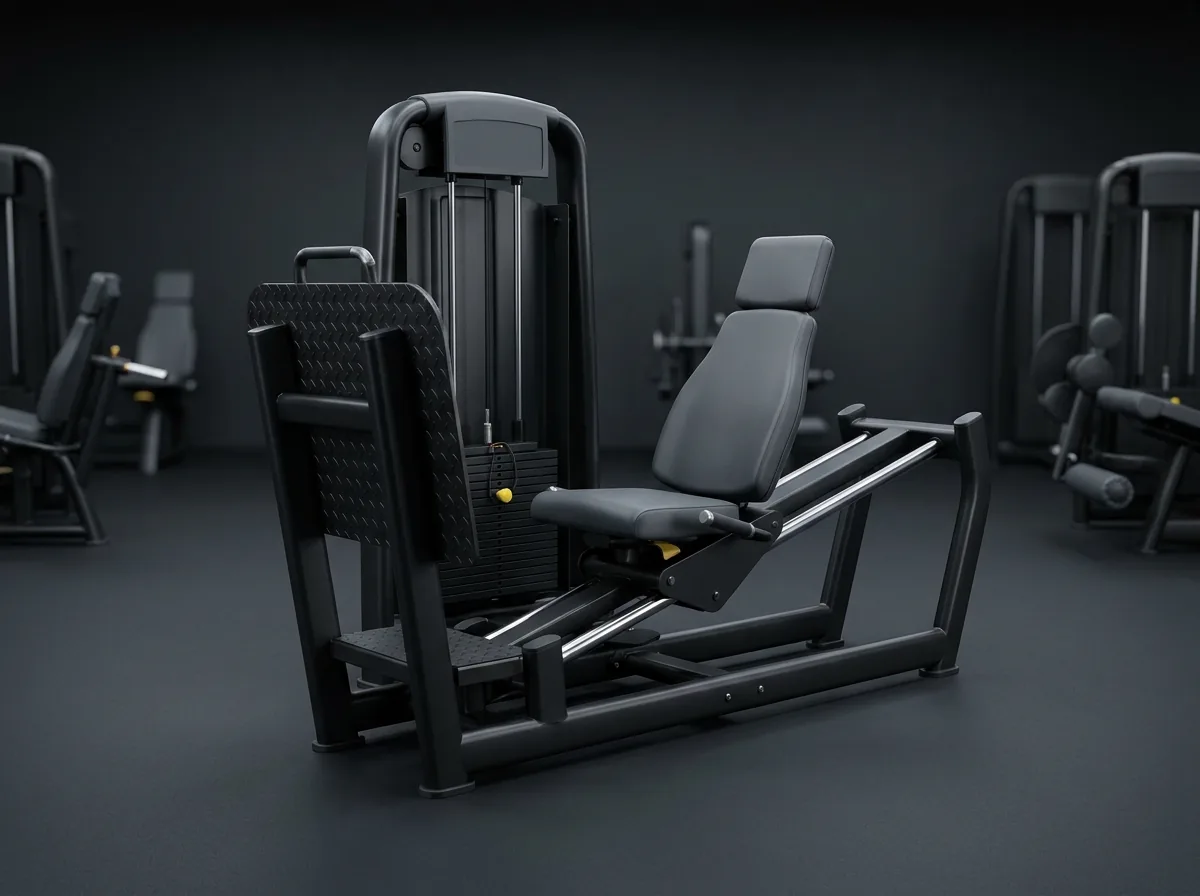
How do you set up the leg press in 20 seconds?
- 1. Adjust the Backrest Angle for Hip Comfort If the machine features an adjustable seatback tilt, set it to a middle angle (typically 100 to 110 degrees relative to the sled travel path) so your hips have enough room to flex deeply without pinching the front of your hip capsule.
- 2. Set the Sled Distance (Seat Carriage Position) Sit firmly in the seat and pull the yellow carriage release lever under your thighs. Slide the seat forward or backward until your knees bend to an exact 90-degree angle when your feet sit flat on the footplate. Never cram yourself so close that your tailbone peels off the seat pad.
- 3. Position Your Feet Hip-Width Apart in the Centre of the Plate Place both feet in the middle of the platform at hip-to-shoulder width with your toes turned slightly outward at 10 to 15 degrees. Ensure the entire sole of your shoe, especially the centre of your heel, stays planted firmly on the textured metal surface.
- 4. Anchor Your Pelvis and Grip the Side Handles Select 60 kg for men or 40 kg for women on the weight stack. Hold the padded handles on either side of the seat and pull your hips downward and backward into the crease of the seat cushion so your lumbar spine stays neutral.
- 5. Align Knees with Your Second and Third Toes Before pushing the platform, check that your kneecaps point in the exact same line as your second and third toes. Maintain this outward tracking width on both the push and the return.
Log both your seat carriage number and backrest angle in Gym.Coach so your knee flexion depth stays consistent every week.
Execution: tempo, breathing, range of motion
- Concentric Phase: 1 Second Drive (Exhale) Inhale to brace your core, then exhale forcefully as you drive through your mid-foot and heels to extend your legs over 1 controlled second. Stop just short of mechanical knee lockout, leaving a soft 5-degree bend in the knee joint so tension stays inside the quadriceps musculature.
- Isometric Transition: 1 Second Hold Hold the extended position for 1 second while contracting your quads and keeping your lower back pressed into the backrest. Never let your knees snap backward into hyperextension.
- Eccentric Lowering Phase: 3 Seconds Lowering (Inhale) Inhale slowly through your nose and bend your knees and hips over a strict 3-second count until your thighs reach roughly a 90-degree angle to your shins. Stop and reverse the movement 1 centimetre before the moving weight plate touches the rest of the stack.
Complete 3 working sets of 8 to 12 repetitions with a strict 90-second rest interval between sets. (1-1-3 tempo / 90s).
The 5 mistakes you see every day on the leg press
- 1. Locking the Knees Hard at the Top of the Rep Snapping the knees into full bone-on-bone extension transfers heavy load off the muscles and directly onto the posterior knee capsule and meniscus. Always finish each push with a slight, active bend in the knees.
- 2. Letting the Knees Cave Inward (Knee Valgus) Allowing the knees to collapse toward each other during the push places high shear stress on the medial collateral ligament (MCL) and patellofemoral joint. Actively push your knees slightly outward in line with your toes.
- 3. Lifting the Heels Off the Platform Pushing through your tiptoes happens when your feet are placed too low on the sled or your ankles lack dorsiflexion. Move your feet 5 centimetres higher up the plate and drive straight through your heels and mid-foot.
- 4. Rounding the Lower Back at the Bottom (Butt Wink) Setting the seat carriage too close to the plate forces your pelvis to tuck underneath you at the bottom of the rep, compressing the lumbar discs under load. Move the seat carriage back by one notch so your sacrum never leaves the pad.
- 5. Pushing on Your Own Knees with Your Hands Taking your hands off the side handles to push against your thighs destabilizes your pelvis and hides a load that is too heavy. Keep both hands locked onto the side grips to pull your hips into the seat.
Which starting weight should you choose and how do you progress?
Because the quadriceps and glutes are the largest muscle groups in the human body, beginners at Anytime Fitness or Jetts Fitness can comfortably start at 60 kg (men) and 40 kg (women). Follow the double progression rule: once you complete 3 sets of 12 reps with a 3-second eccentric lowering phase and zero knee cave, increase the stack by 5 kg. Over 12 weeks, average lifters progress to 95-110 kg (men) and 65-75 kg (women).
Double Progression Table (AU Metric KG):
| Session | Sets x Reps (1-1-3 Tempo) | Weight (KG) |
|---|---|---|
| Session 1 | 3x10 | 60 kg (F: 40 kg) |
| Session 2 | 3x11 | 60 kg (F: 40 kg) |
| Session 3 | 3x12 | 60 kg (F: 40 kg) |
| Session 4 | 3x10 | 62.5 kg (+2.5 kg step) |
Always prioritize full 90-degree knee depth over ego-loading the stack with partial half-repetitions.
How does the leg press differ by brand?
| Machine Brand & Series | Carriage & Backrest Controls | Mechanical Sled Behavior |
|---|---|---|
| Matrix Ultra / Versa Series (common in Anytime Fitness and Snap Fitness) | Central yellow pull-handle between the legs slides the seat carriage along a numbered linear rail. | Four-bar linkage moves the seat pad backward along a slight upward arc to maintain optimal hip-to-knee angles. |
| Technogym Selection Pro / Artis (common in Snap Fitness and Plus Fitness) | Pneumatic yellow lever on the right side of the seat lets you adjust carriage position without standing up. | Wide multi-angle footplate features subtle raised ridges; place your arches over the middle ridge for balanced quad-glute recruitment. |
| Life Fitness Insignia / Signature / Insignia Series (common in Jetts Fitness and Plus Fitness) | Dual adjustment: upright backrest angle pin plus a heavy-duty linear seat slide. | Here the seat carriage travels backward while the footplate remains stationary; keep your eyes focused straight ahead. |
| Gym80 Sygnum (Fitness First AU, Doherty’s & performance 24/7 clubs) | Heavy-duty steel ratcheting seat pin with laser-etched position numbers | Direct mechanical cam profile; use the +2.5 kg micro-weight increment when progressing after 3x12. |
Frequently asked questions
How is the seated horizontal leg press different from the 45-degree plate-loaded sled?
A selectorized seated leg press moves horizontally or along a linkage cable system with a weight pin, whereas a 45-degree sled requires manually loading circular weight plates onto an angled track. The selectorized version is safer for solo lifters, faster to adjust, and offers a smoother resistance curve across the full range of motion.
Where should I place my feet if I have mild knee discomfort?
Move both feet 5 to 8 centimetres higher on the footplate so your shins remain closer to perpendicular with the platform at the bottom of the rep. This reduces anterior knee shear and shifts more of the workload onto your glutes and hips.
Should my knees go past my toes on the leg press?
For healthy knees, moderate forward knee travel is completely natural as long as your whole heel stays glued to the footplate. If your heels lift off the platform at the bottom, your feet are positioned too low.
How often should I train the leg press in Gym.Coach?
Gym.Coach supports 95% of commercial gym equipment and rotates 5 smartly chosen machines every workout so your body recovers evenly. Training the leg press 2 times per week with at least 48 hours of recovery between lower-body sessions delivers optimal strength and muscle gains.