What the chest press does and who it is for
The seated chest press machine is the foundational horizontal pushing station found on the strength floor of Planet Fitness, Crunch Fitness, Anytime Fitness, and LA Fitness. Unlike a free-weight barbell bench press, where a significant percentage of neural drive is spent preventing the bar from drifting forward or backward, the chest press machine guides your pressing path along a fixed or converging mechanical arc. This built-in stability allows beginners and experienced lifters alike to direct maximal mechanical tension straight into the pectoralis major, anterior deltoids, and triceps brachii without needing a spotter.
Biochemically and mechanically, the machine creates horizontal adduction of the humerus combined with elbow extension. Because the backrest braces your thoracic spine, every unit of force you apply against the handles translates into productive work across the chest fibers. In Gym.Coach, which supports 95% of commercial strength equipment across major and boutique brands and selects 5 smartly chosen machines every workout to keep your entire body balanced, the seated chest press serves as the primary upper-body anterior push anchor.
Training on a pin-selected chest press also makes tempo control and double progression completely objective. You can pause safely just above the weight stack at peak stretch, drive smoothly to full extension, and track exact load increments from week to week without shoulder instability limiting your output.
In American fitness centers including Planet Fitness, Crunch Fitness, LA Fitness, Anytime Fitness US, and 24 Hour Fitness, you will find this station from brands like Matrix, Technogym, Life Fitness, or Gym80. Our US program uses color-coded seat settings so you can customize your setup in seconds, recruit maximum muscle fibers around the joint center, and progress in +5 lbs increments (from 55 lbs for men and 35 lbs for women up to 90 to 100 lbs lbs over 12 weeks).
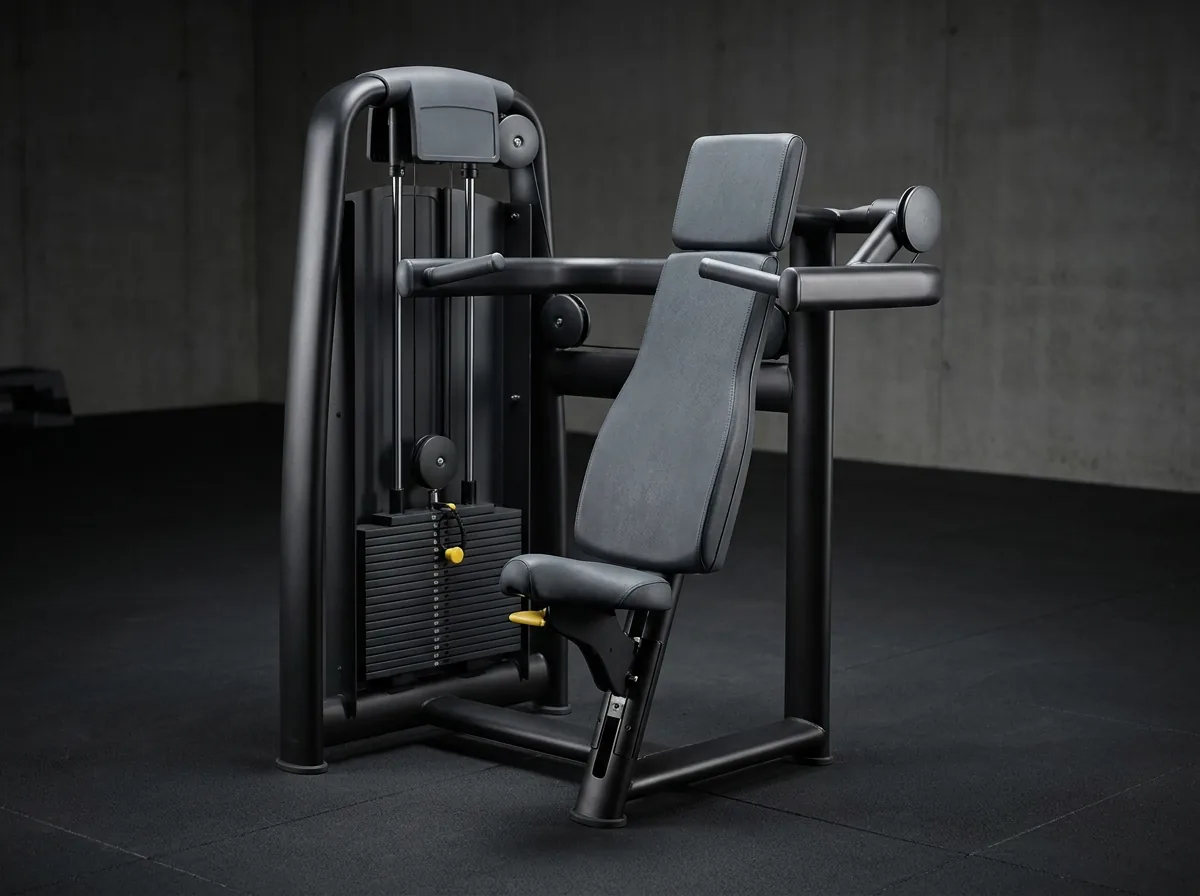
How do you set up the chest press in 20 seconds?
- 1. Adjust the Seat Height to Mid-Chest Level Pull the yellow or orange seat lever beneath the cushion and raise or lower the seat until the horizontal handles align directly with your mid-chest (nipple line or lower sternum). If the seat is too low, the handles sit near your collarbones and shift stress onto the rotator cuff and upper traps.
- 2. Set the Start-Position Range Limiter (Back Pad or Arm Lever) On machines equipped with a start-angle adjustment or movable backrest, set the handles so your elbows begin roughly in line with your torso or just 10 degrees behind the plane of your back. Avoid setting the handles so far back that the head of your humerus rolls forward in the shoulder socket before you even press.
- 3. Retract and Depress Your Shoulder Blades Sit tall and draw your scapulae together and slightly downward against the backrest, as if tucking the bottom corners of your shoulder blades into your back pockets. Keep your upper back glued to the pad throughout the entire set.
- 4. Plant Your Feet and Establish Five-Point Contact Place both feet flat on the floor slightly wider than hip-width, or press your heels onto the forward foot catch if the machine has a pre-stretch foot pedal. Maintain firm contact at five points: head, upper back, glutes, left foot, and right foot.
- 5. Select Your Grip and Stack Neutral Wrists Insert the selector pin at 55 lbs for men or 35 lbs for women. Grip the horizontal handles with a full thumb-around wrap slightly wider than shoulder-width, keeping your knuckles pointed straight forward so your wrists sit stacked directly in line with your forearms.
Write down your exact seat notch number in Gym.Coach so you replicate the identical joint angle on every visit.
Execution: tempo, breathing, range of motion
- Concentric Phase: 1 Second Press (Exhale) If your machine features a foot-assist pedal, press it down to bring the handles into your starting position, secure your grip, and release the pedal. Exhale forcefully through your mouth and drive the handles forward in a smooth 1-second concentric push until your arms are extended with a micro-bend remaining at the elbows.
- Isometric Peak Contraction: 1 Second Hold Hold the extended position for 1 full second while actively squeezing your biceps inward toward the midline of your chest. Keep the backs of your shoulders pressed firmly against the pad rather than letting your torso protract and round forward.
- Eccentric Lowering Phase: 3 Seconds Lowering (Inhale) Inhale steadily through your nose while lowering the handles back toward your chest over a strict 3-second count (one-thousand-one, one-thousand-two, one-thousand-three). Keep your elbows angled at roughly 45 to 60 degrees relative to your ribcage, and reverse the rep 1 centimeter before the moving weight plate touches the rest of the stack.
Perform 3 working sets of 8 to 12 controlled repetitions. Rest exactly 90 seconds between sets to allow adenosine triphosphate (ATP) and phosphocreatine stores to replenish. (1-1-3 tempo / 90s).
The 5 mistakes you see every day on the chest press
- 1. Flaring Elbows Out to a 90-Degree T-Shape Driving the elbows straight out in line with the shoulder joints narrows the subacromial space and pinches the supraspinatus tendon. Tuck your elbows down to a natural 45 to 60-degree angle relative to your torso to align with the sternal fibers of the chest.
- 2. Letting the Shoulders Roll Forward at Lockout Pushing your shoulders off the pad at the end of the press transfers tension out of the pectorals and into the anterior deltoid and serratus anterior. Keep your scapulae pinned against the upholstery from the first inch to the final repetition.
- 3. Slamming the Weight Stack Between Reps Allowing the plates to crash at the bottom dissipates mechanical tension and uses elastic bounce to launch the next repetition. Pause a hair above the stack so your chest muscles carry 100% of the load through the transition.
- 4. Bending the Wrists Backward Under Load Letting the handles roll up into your fingers hyperextends the radiocarpal joint and leaks pressing power. Seat the handle low across the heel of your palm directly over the radius and ulna bones.
- 5. Arching the Lower Back and Lifting the Glutes Turning a seated press into an exaggerated back-arch press when the weight gets heavy places compressive shear on the lumbar vertebrae. Brace your abdominals as if preparing for a light cough and keep your pelvis anchored to the seat pad.
Which starting weight should you choose and how do you progress?
Most beginners at Planet Fitness or Crunch Fitness start efficiently at 55 lbs (men) or 35 lbs (women). We use a structured double progression system: keep the pin at the same weight until you hit the top of the 8 to 12 rep target across all 3 sets with a strict 3-second lowering phase, then add 5 lbs or 10 lbs. Over 12 weeks of consistent training, average lifters build up to 90-100 lbs (men) and 55-65 lbs (women).
Double Progression Table (US Imperial LBS):
| Session | Sets x Reps (1-1-3 Tempo) | Weight (LBS) |
|---|---|---|
| Session 1 | 3x10 | 55 lbs (F: 35 lbs) |
| Session 2 | 3x11 | 55 lbs (F: 35 lbs) |
| Session 3 | 3x12 | 55 lbs (F: 35 lbs) |
| Session 4 | 3x10 | 60 lbs (+5 lbs step) |
If your gym's stack jumps by 10 lbs per pin hole, flip the built-in 2.5 lbs or 5 lbs add-on weight switch at the top of the tower so you never compromise your 3-second eccentric tempo.
How does the chest press differ by brand?
| Machine Brand & Series | Seat & Lever Adjustments | Biomechanical Path & Practical Note |
|---|---|---|
| Matrix Ultra / Versa Series (common in Planet Fitness and Anytime Fitness) | Numbered ratcheting seat pad plus an integrated foot-assist lever at the base of the frame. | Independent converging press arms move inward as you extend; always step on the foot lever to enter and exit the rep safely. |
| Technogym Selection Pro / Artis (common in Anytime Fitness and LA Fitness) | Visual yellow adjustment flags on the seat post and a 5-point magnetic fractional weight dial on the tower. | PhysioCam variable resistance makes the initial stretched position slightly lighter and increases torque through the midrange. |
| Life Fitness Insignia / Signature / Insignia Series (common in Crunch Fitness and LA Fitness) | Pull-pin seat column paired with an overhead or side-mounted starting-angle selector pin. | Features dual horizontal and neutral vertical grips; start with the horizontal grip and use the neutral grip if you have prior shoulder impingement. |
| Gym80 Sygnum & Hammer Strength Select (24 Hour Fitness, Crunch, performance clubs) | Heavy-duty steel ratcheting seat pin with laser-etched position numbers | Direct mechanical cam profile; use the +5 lbs drop-down add-on weight when stepping up after 3x12. |
Frequently asked questions
Should I use the horizontal grip or the vertical neutral handles?
Use the horizontal (pronated) grip for standard workouts because an elbow angle of 45 to 60 degrees lines up directly with the sternal fibers of the pectoralis major. Switch to the vertical (neutral) handles if you experience front-shoulder pinching, as a neutral palm orientation externally rotates the humerus and widens the subacromial space.
Is the seated chest press machine as effective for muscle growth as the barbell bench press?
Yes. Electromyography (EMG) and hypertrophy studies show that when sets are taken close to muscular failure, stabilized machine presses produce equal pectoral hypertrophy to free weights because reduced stabilization demands let you direct higher mechanical tension straight into the target muscle fibers.
Why do I feel the chest press mostly in my front shoulders or triceps?
That almost always happens for two reasons: your seat is set too low (placing the handles at collarbone height instead of mid-chest), or you are letting your shoulder blades protract off the pad as you push. Raise the seat by two notches and actively pinch your shoulder blades against the upholstery before initiating the press.
How does Gym.Coach integrate the chest press into my weekly routine?
Gym.Coach maps 95% of commercial gym machines across major and independent brands and builds each session around 5 smartly selected stations so your entire body stays in muscular balance. Whenever the seated chest press is in your lineup, the app pairs it with complementary pulling and lower-body movements and calculates your exact next weight target.