What the lat pulldown does and who it is for
The lat pulldown machine is the benchmark vertical pulling station in Planet Fitness, Crunch Fitness, Anytime Fitness, and LA Fitness. While bodyweight pull-ups require lifting 100% of your body mass from repetition one, often forcing beginners to swing their legs or shrug their shoulders, the lat pulldown uses an overhead pulley or diverging lever arm with a padded thigh roller. This lets you scale vertical pulling resistance to the exact kilogram or pound so your latissimus dorsi and upper-back musculature learn proper scapular depression before heavy loading.
Mechanically, the lat pulldown trains shoulder adduction and shoulder extension in the frontal and scapular planes. By pulling the bar or independent handles down toward your upper chest while keeping your ribcage elevated, you create a strong V-taper silhouette and reinforce the postural muscles that counteract desk-related thoracic slouching.
In Gym.Coach, which supports 95% of commercial gym machines across major and independent brands and builds every session around 5 balanced exercises, the lat pulldown serves as the primary vertical pull to balance out overhead and horizontal pressing.
In American fitness centers including Planet Fitness, Crunch Fitness, LA Fitness, Anytime Fitness US, and 24 Hour Fitness, you will find this station from brands like Matrix, Technogym, Life Fitness, or Gym80. Our US program uses color-coded seat settings so you can customize your setup in seconds, recruit maximum muscle fibers around the joint center, and progress in +5 lbs increments (from 65 lbs for men and 45 lbs for women up to 100 to 120 lbs lbs over 12 weeks).
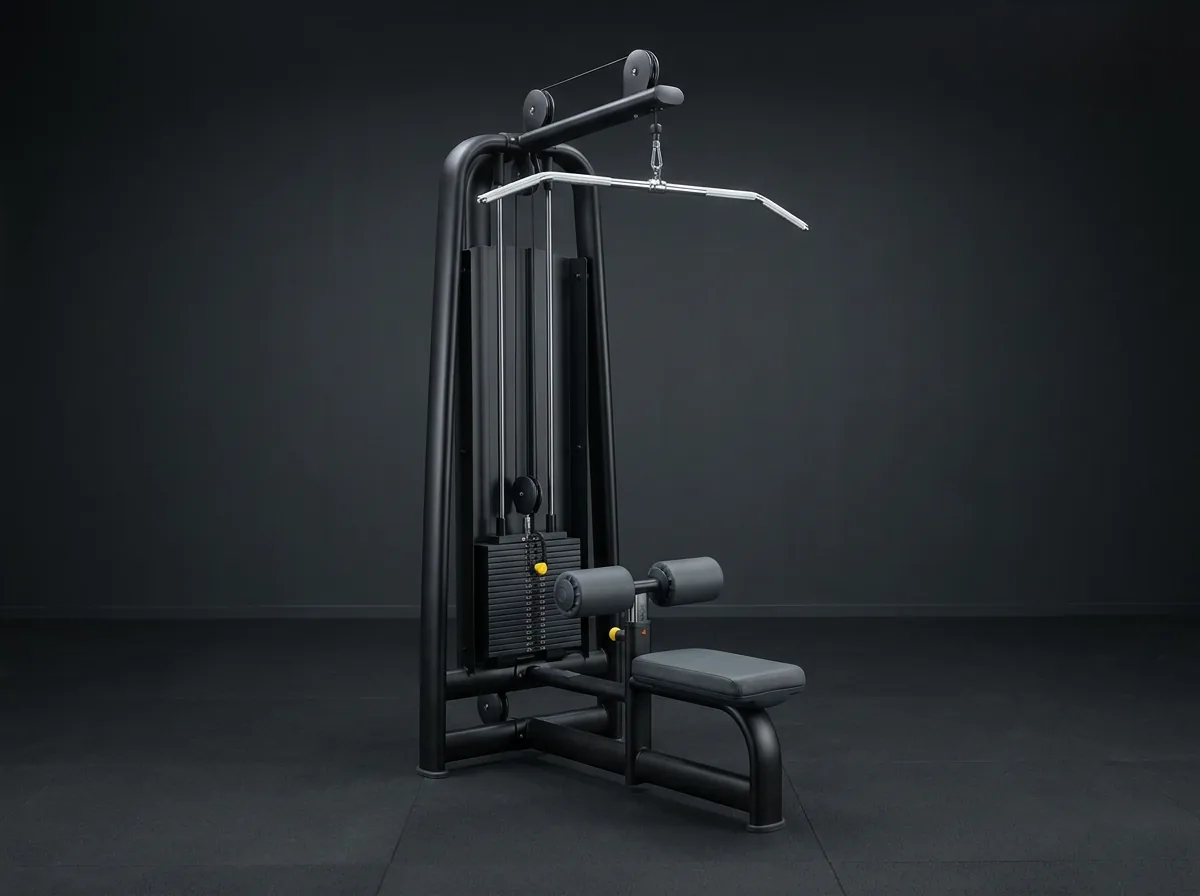
How do you set up the lat pulldown in 20 seconds?
- 1. Set the Weight Pin and Check the Overhead Attachment Insert the selector pin at 65 lbs for men or 45 lbs for women before sitting down. Ensure a standard wide lat bar with angled ends is clipped securely to the overhead carabiner (or check the handle height on a fixed-arm diverging machine).
- 2. Adjust the Padded Thigh Rollers Snugly Over Your Quads Sit on the seat with your feet flat on the floor and pull the spring pin on the thigh pad column. Lower the rollers until they press firmly against your upper thighs, locking your pelvis to the seat so the weight stack cannot pull your body upward.
- 3. Establish a Grip 1.5x Shoulder Width Stand up to grasp the bar just outside shoulder width, right where the knurled bar begins to angle downward. Wrap your fingers securely over the bar; using a thumbless hook grip (thumb alongside the index finger) can help reduce forearm flexing and improve mind-muscle connection with the lats.
- 4. Sit Down with Arms Extended and Chest Proud Holding the bar, sit back down and slide your knees squarely under the thigh rollers. Lift your breastbone toward the ceiling and lean your upper torso back by a modest 10 to 15 degrees from vertical, keeping your lower back neutral.
- 5. Depress Your Scapulae Before Bending Your Elbows Before pulling with your arms, draw your shoulder blades down away from your ears (scapular depression). Maintain this long-neck position as your starting posture.
Record your thigh roller hole number in Gym.Coach so you lock in fast without trial and error.
Execution: tempo, breathing, range of motion
- Concentric Phase: 1 Second Pull (Exhale) Exhale and drive your elbows straight down and in toward your sides over a smooth 1-second pull until the bar touches or hovers 2 centimeters above your upper chest and collarbones. Visualize your hands as passive hooks while your elbows lead the movement.
- Isometric Peak Contraction: 1 Second Squeeze Pause at your upper chest for 1 full second. Squeeze your armpits downward as if holding a rolled towel under each arm, keeping your chest lifted to meet the bar.
- Eccentric Return Phase: 3 Seconds Stretching Return (Inhale) Inhale steadily and guide the bar back overhead over a controlled 3-second count until your elbows are fully extended and your lats feel a deep stretch along your ribcage. Stop just before the moving plate touches the stack.
Perform 3 working sets of 8 to 12 repetitions, resting 90 seconds between sets to maintain grip and lat output. (1-1-3 tempo / 90s).
The 5 mistakes you see every day on the lat pulldown
- 1. Pulling the Bar Behind the Neck Bringing the bar behind your head forces the glenohumeral joint into extreme external rotation and abduction while flexing the cervical spine forward, a major cause of rotator cuff impingement. Always pull the bar to the front of your upper chest.
- 2. Swinging the Torso Backward Like a Rowing Ergometer Using lower-back momentum to swing 45 degrees backward turns a vertical lat pulldown into a sloppy bodyweight momentum swing. Keep your torso fixed at a constant 10 to 15-degree angle from start to finish.
- 3. Taking an Ultra-Wide Grip Out at the Very Tips Gripping at the extreme ends of a long bar reduces total vertical range of motion and decreases mechanical work performed by the lats. A grip roughly 1.5 times bi-acromial shoulder width provides the longest muscle excursion.
- 4. Pushing the Bar Down Like a Tricep Pushdown at the Bottom Pulling the bar down to your stomach by flaring your elbows backward and rolling your shoulders forward takes the load off the lats and puts it onto the wrists and rotator cuff. Stop the pull at collarbone-to-upper-chest height.
- 5. Shrugging the Shoulders Up Toward the Ears Letting the upper traps stay elevated throughout the pull prevents the lower trapezius and latissimus dorsi from engaging properly. Reset every repetition by sliding your shoulder blades down your ribcage first.
Which starting weight should you choose and how do you progress?
Most beginners at Planet Fitness or Crunch Fitness build immediate form mastery starting at 65 lbs (men) or 45 lbs (women). Use double progression: when you achieve 3 sets of 12 clean collarbone touches with a 3-second eccentric return and zero torso swing, move the pin down by 5 lbs or 10 lbs. Over 12 weeks, average lifters progress to 100-120 lbs (men) and 65-75 lbs (women).
Double Progression Table (US Imperial LBS):
| Session | Sets x Reps (1-1-3 Tempo) | Weight (LBS) |
|---|---|---|
| Session 1 | 3x10 | 65 lbs (F: 45 lbs) |
| Session 2 | 3x11 | 65 lbs (F: 45 lbs) |
| Session 3 | 3x12 | 65 lbs (F: 45 lbs) |
| Session 4 | 3x10 | 70 lbs (+5 lbs step) |
Never count a repetition where you had to yank with your lower back or stop the bar at forehead height.
How does the lat pulldown differ by brand?
| Machine Brand & Series | Thigh Pad & Handle Design | Mechanical Path & Practical Note |
|---|---|---|
| Matrix Ultra / Versa Series (common in Planet Fitness and Anytime Fitness) | Angled ratcheting thigh pads plus either a classic overhead cable pulley or independent diverging lever arms. | On Matrix Diverging Lat Pulldowns, the arms travel slightly outward as they come down, closely matching natural scapular downward rotation. |
| Technogym Selection Pro / Artis (common in Anytime Fitness and LA Fitness) | Yellow-flagged seat height adjustment paired with fixed stationary thigh pads and independent overhead lever arms. | Unlike standard machines where you move the thigh pad, on Technogym Selection you raise the seat itself until your thighs press firmly into the top rollers. |
| Life Fitness Insignia / Signature / Insignia Series (common in Crunch Fitness and LA Fitness) | Classic overhead high pulley or Dual Adjustable Pulley with a telescoping spring-pin thigh roller. | Provides a completely free vertical cable path, allowing you to swap between wide pronated bars and neutral MAG-style handles. |
| Gym80 Sygnum & Hammer Strength Select (24 Hour Fitness, Crunch, performance clubs) | Heavy-duty steel ratcheting seat pin with laser-etched position numbers | Direct mechanical cam profile; use the +5 lbs drop-down add-on weight when stepping up after 3x12. |
Frequently asked questions
Is an overhand wide grip better than an underhand close grip?
Both grips build the lats effectively. A medium-wide overhand grip emphasizes shoulder adduction and the outer teres major / upper lat sweep, whereas an underhand (supinated) shoulder-width grip places the biceps brachii in a stronger mechanical line and increases sagittal-plane shoulder extension.
Why do my forearms and biceps tire out before my back feels worked?
Most beginners squeeze the bar too tightly and initiate the pull by curling their wrists and elbows. Loosen your thumb into a hook grip, start each repetition by sliding your shoulder blades down your back, and think about driving your elbows down toward your hips.
How low should I pull the bar on each repetition?
Pull the bar down until it touches or comes within 2 centimeters of your upper chest just below the collarbones. Pulling any lower toward your belly button causes your elbows to point backward and forces your shoulders to roll forward.
How does Gym.Coach pair the lat pulldown with other exercises?
Gym.Coach supports 95% of commercial strength equipment and selects 5 smartly coordinated machines per workout. It automatically pairs vertical pulls like the lat pulldown with horizontal rows and pressing machines so your shoulder girdle develops balanced strength.