What the leg extension does and who it is for
The seated leg extension machine is the definitive single-joint quadriceps isolation station found in Planet Fitness, Crunch Fitness, Anytime Fitness, and LA Fitness. While compound lower-body lifts like squats and leg presses train knee and hip extension simultaneously, the bi-articular rectus femoris muscle (which runs down the center of your front thigh) cannot contract maximally during a squat because it is simultaneously lengthening at the knee and shortening at the hip. Because the seated leg extension holds your hip angle fixed, it recruits all four heads of the quadriceps, including the rectus femoris, with unmatched precision.
Mechanically, the exercise produces pure open-chain knee extension against a padded cylindrical shin roller attached to a cam-driven weight stack. Strong quadriceps act as the primary dynamic shock absorbers for the patellofemoral joint during stairs, running, and deceleration.
In Gym.Coach, which supports 95% of commercial strength machines and selects 5 smartly balanced stations every workout, the leg extension pairs directly in your weekly rotation with the seated leg curl to keep knee extensor-to-flexor strength ratios healthy.
In American fitness centers including Planet Fitness, Crunch Fitness, LA Fitness, Anytime Fitness US, and 24 Hour Fitness, you will find this station from brands like Matrix, Technogym, Life Fitness, or Gym80. Our US program uses color-coded seat settings so you can customize your setup in seconds, recruit maximum muscle fibers around the joint center, and progress in +5 lbs increments (from 55 lbs for men and 35 lbs for women up to 90 to 110 lbs lbs over 12 weeks).
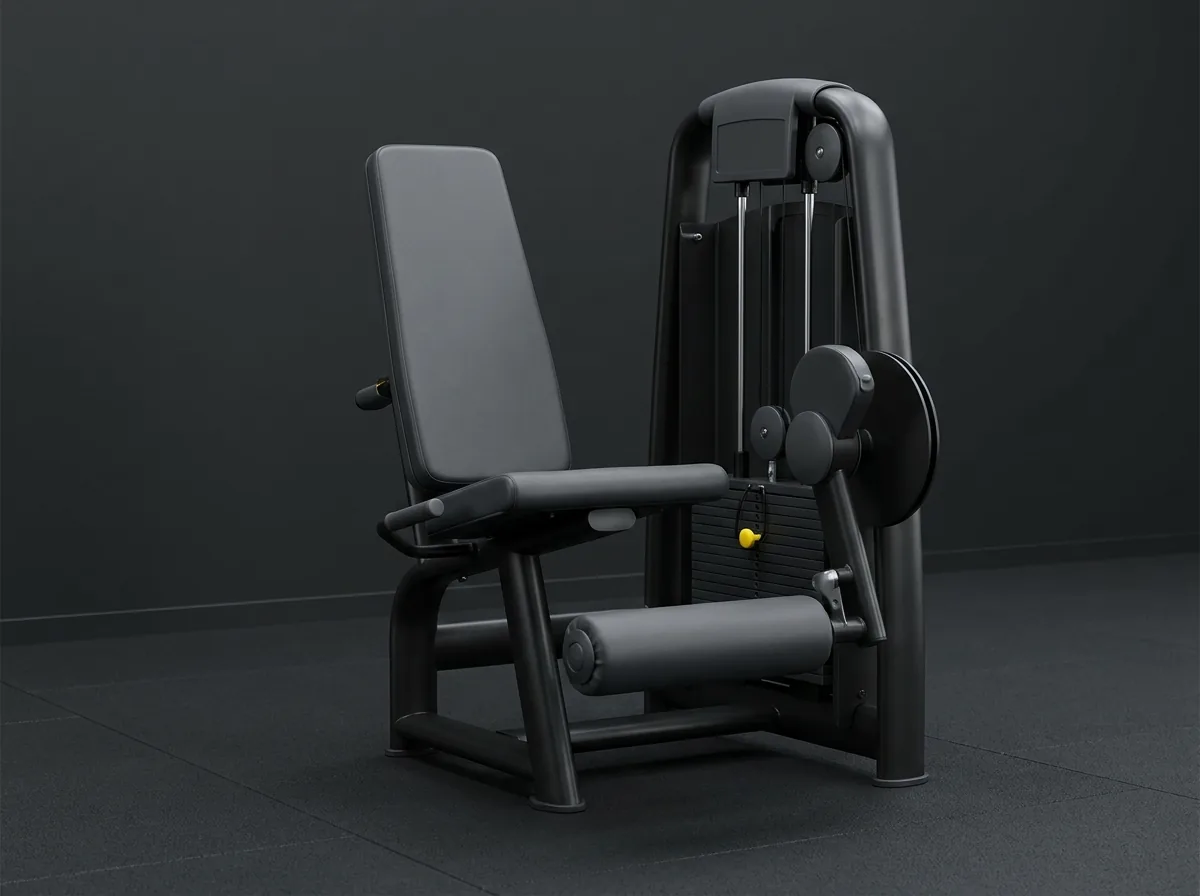
How do you set up the leg extension in 20 seconds?
- 1. Align Your Knee Joint Directly with the Machine Red/Yellow Pivot Dot Sit on the seat and adjust the backrest depth forward or backward until the backs of your knees rest snugly against the curved front edge of the seat cushion, and your outer knee joint lines up directly with the circular mechanical pivot axis of the lever arm.
- 2. Adjust the Shin Pad Height Just Above the Ankle Joint Pull the spring pin on the lower leg arm and position the cylindrical roller pad so it rests against the lowest part of your shins, right in the curve just above your ankle bones (malleoli). Never place the pad high up on your mid-shin or down over the top of your foot.
- 3. Set the Starting Range-of-Motion Angle Pull the range-limiter pin on the cam and bring the lever arm back so your knees start at a full 90 to 100-degree bend without smashing the weight stack.
- 4. Select Your Starting Weight and Buckle In (If Equipped) Insert the selector pin at 55 lbs for men or 35 lbs for women. If the seat has a lap seatbelt, clip it across your hips, and grip the side handles firmly to pull your glutes down into the seat.
- 5. Dorsiflex Your Ankles (Pull Toes Toward Shins) Before lifting, flex your feet upward so your toes point straight toward the ceiling. Keeping your ankles dorsiflexed tightens the lower-leg fascia and prevents knee rotation.
Log both your backrest number and shin roller hole number in Gym.Coach; even one notch off changes knee torque significantly.
Execution: tempo, breathing, range of motion
- Concentric Phase: 1 Second Extension (Exhale) Exhale forcefully and extend both legs upward in a smooth 1-second arc until your knees are completely straight. Keep your hips and thighs glued to the seat pad rather than kicking the weight up with momentum.
- Isometric Peak Contraction: 1 Second Top Hold Hold the fully extended top position for 1 full second, squeezing your quadriceps hard while keeping your toes pulled back toward your shins. Unlike the leg press where axial load compresses the joint, full terminal knee extension here is safe and essential to recruit the vastus medialis.
- Eccentric Lowering Phase: 3 Seconds Lowering (Inhale) Inhale steadily through your nose while lowering the shin roller over a strict 3-second count until your knees return to the 90-degree starting position. Stop 1 centimeter before the moving weight plate touches the stack.
Perform 3 working sets of 10 to 12 repetitions with a 90-second rest interval between sets. (1-1-3 tempo / 90s).
The 5 mistakes you see every day on the leg extension
- 1. Misaligning the Knee Joint with the Machine Pivot Axis If the backrest is set too far back, your knees sit several inches behind the machine pivot, causing the roller pad to scrape up and down your shins and creating abnormal shear inside the knee joint. Slide the backrest forward until your knee joint matches the pivot dot.
- 2. Kicking the Weight Up and Dropping It Fast Ballistically kicking a heavy stack upward uses momentum to skip the midrange and leaves the top 20 degrees of extension completely unloaded because the weight flies up on its own. Use a controlled 1-second lift and a 1-second pause at the top.
- 3. Lifting Your Hips Off the Seat to Cheat the Last Reps Standing up out of the seat cushion when the quads burn shifts your hip angle and shortens the range of motion. Pull upward on the side handles to lock your pelvis into the seat.
- 4. Turning Toes Inward or Outward Under Heavy Load Rotating your lower legs internally or externally places rotational torque on the meniscus and collateral ligaments. Keep your kneecaps and toes pointed straight ahead.
- 5. Cutting Out the Top 15 Degrees of Extension Stopping your reps before your legs are fully straight happens when the weight is too heavy. Drop the pin by one plate and pause at full horizontal extension on every repetition.
Which starting weight should you choose and how do you progress?
Beginners at Planet Fitness or Crunch Fitness should start at 55 lbs (men) or 35 lbs (women). Use double progression: only increase the load by 5 lbs or 10 lbs when you can hold the top of all 12 reps across 3 sets for a full 1-second isometric squeeze followed by a 3-second lowering phase. Over 12 weeks, average lifters progress to 90-110 lbs (men) and 60-75 lbs (women).
Double Progression Table (US Imperial LBS):
| Session | Sets x Reps (1-1-3 Tempo) | Weight (LBS) |
|---|---|---|
| Session 1 | 3x10 | 55 lbs (F: 35 lbs) |
| Session 2 | 3x11 | 55 lbs (F: 35 lbs) |
| Session 3 | 3x12 | 55 lbs (F: 35 lbs) |
| Session 4 | 3x10 | 60 lbs (+5 lbs step) |
Never count a repetition where your shins fail to reach full horizontal extension.
How does the leg extension differ by brand?
| Machine Brand & Series | Backrest & Shin Pad Controls | Cam Profile & Practical Note |
|---|---|---|
| Matrix Ultra / Versa Series (common in Planet Fitness and Anytime Fitness) | Gas-assisted ratcheting backrest, numbered shin pad arm, and clearly marked pivot indicator on the side cover. | Self-adjusting or multi-notch ankle roller keeps pressure evenly distributed across the distal tibia. |
| Technogym Selection Pro / Artis (common in Anytime Fitness and LA Fitness) | Rear backrest lever operable while seated, paired with a self-aligning tibial pad that requires no height pin. | PhysioCam variable cam reduces torque in the vulnerable 90-degree bent position and peaks gently through midrange. |
| Life Fitness Insignia / Signature / Insignia Series (common in Crunch Fitness and LA Fitness) | Yellow pull-pin backrest slide, 5-position start-angle cam dial, and numbered shin pad adjuster. | Seat pan is angled slightly upward at the knees to place the rectus femoris under a comfortable pre-stretch. |
| Gym80 Sygnum & Hammer Strength Select (24 Hour Fitness, Crunch, performance clubs) | Heavy-duty steel ratcheting seat pin with laser-etched position numbers | Direct mechanical cam profile; use the +5 lbs drop-down add-on weight when stepping up after 3x12. |
Frequently asked questions
Are leg extensions bad for your knees?
For lifters with intact knee ligaments, controlled leg extensions are completely safe and are widely prescribed in physical therapy to rebuild quadriceps strength. Knee irritation only occurs when lifters misalign the knee joint with the pivot dot or kick excessive weights ballistically.
Why do we lock out at the top of a leg extension when we avoid locking out on a leg press?
On a leg press, the heavy sled pushes axially down the shaft of your tibia and femur, so locking out transfers compressive weight onto the bones. On a leg extension, resistance acts perpendicular to your shin bone, so straightening your legs completely simply contracts the quadriceps at peak shortening without axial bone compression.
Should I point my toes in or out to target the inner or outer quad?
No. Rotating your tibia under heavy open-chain load twists the knee joint capsule without meaningfully changing regional muscle growth. Keep your toes pointed straight up and focus on full range of motion and progressive load.
How does Gym.Coach pair the leg extension in my program?
Gym.Coach supports 95% of commercial gym machines and selects 5 smartly coordinated stations every workout. It ensures quadriceps work is systematically balanced with hamstring work on the seated leg curl so your knee joints stay stable.