What the seated leg curl does and who it is for
The seated leg curl machine is the premier posterior-thigh isolation station found across Planet Fitness, Crunch Fitness, Anytime Fitness, and LA Fitness. Because three of the four hamstring muscles cross both the hip and the knee joints, sitting upright with your hips flexed at 90 degrees places the hamstrings into an elongated pre-stretch before you even begin bending your knees. Multiple controlled hypertrophy studies have demonstrated that training the hamstrings at longer muscle lengths in the seated leg curl produces significantly greater muscle growth than lying prone leg curls.
Mechanically, the exercise trains open-chain knee flexion against an Achilles roller pad while a padded thigh bolster clamps your femurs firmly down against the seat. Strong hamstrings decelerate the shin during sprinting and walking, protect the anterior cruciate ligament (ACL) from forward tibial shear, and balance out quad-dominant lower bodies.
In Gym.Coach, which supports 95% of commercial gym machines across major and independent brands and selects 5 balanced stations every workout, the seated leg curl serves as the primary hamstring builder alongside the leg press and leg extension.
In American fitness centers including Planet Fitness, Crunch Fitness, LA Fitness, Anytime Fitness US, and 24 Hour Fitness, you will find this station from brands like Matrix, Technogym, Life Fitness, or Gym80. Our US program uses color-coded seat settings so you can customize your setup in seconds, recruit maximum muscle fibers around the joint center, and progress in +5 lbs increments (from 55 lbs for men and 35 lbs for women up to 90 to 105 lbs lbs over 12 weeks).
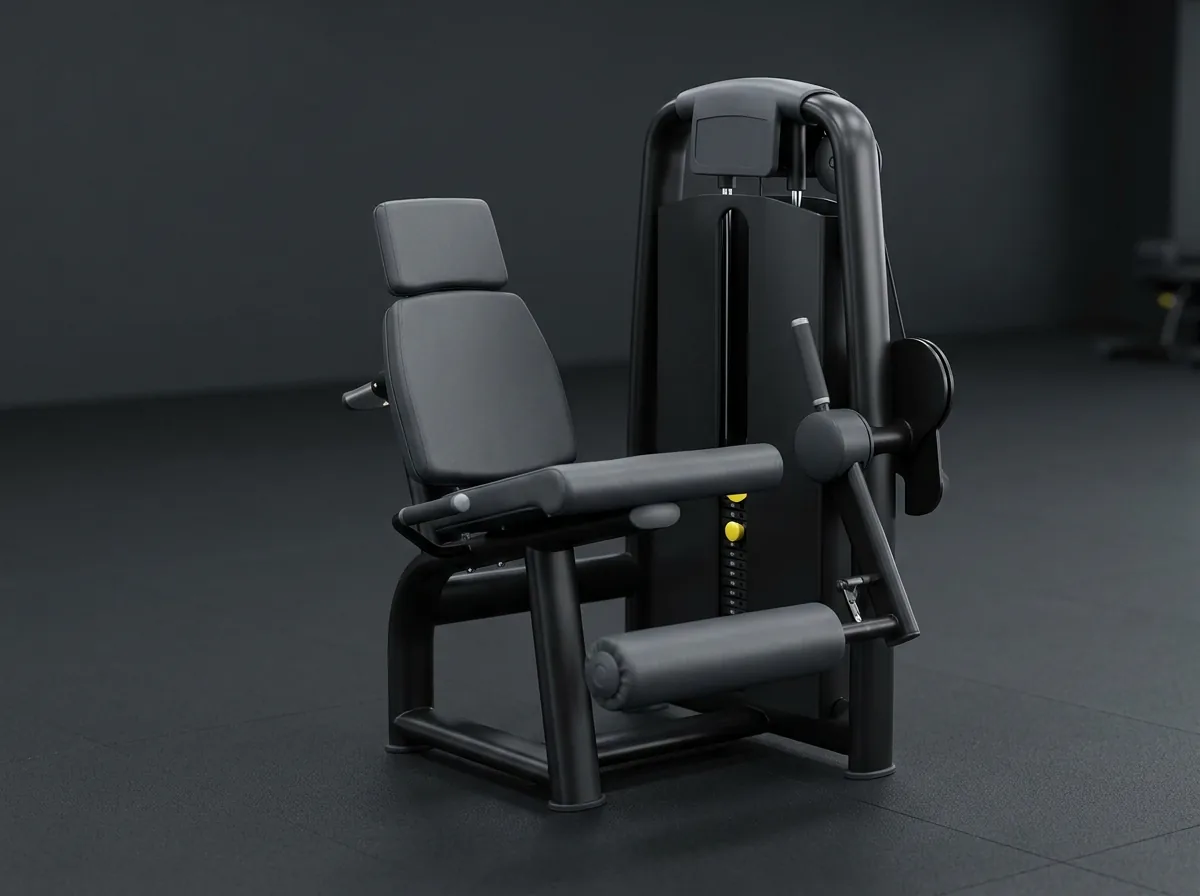
How do you set up the seated leg curl in 20 seconds?
- 1. Align Your Knee Joint with the Machine Pivot Dot Sit against the backrest and adjust the seat depth forward or backward until the back of your knee joint clears the front edge of the seat cushion by 2 centimeters and your outer knee lines up directly with the circular cam pivot.
- 2. Position the Lower Roller Pad Over Your Achilles Tendon Adjust the lever arm length so the padded ankle roller rests directly behind your lower calves just above the heel bone (calcaneus) when your legs are extended. Never set the roller high up in the middle of your calf muscle belly.
- 3. Raise the Starting Range-of-Motion Angle for Full Stretch Use the cam range pin to set the starting arm high enough that your legs begin completely straight (or with a soft 5-degree bend) so you feel a mild hamstring stretch before pulling.
- 4. Lock the Lap Thigh Pad Snugly Over Your Lower Quads Select 55 lbs for men or 35 lbs for women on the weight stack. Pull the hinged lap bolster down tightly across your lower thighs just above your kneecaps until it clicks into place, leaving zero gap for your knees to lift up.
- 5. Dorsiflex Your Ankles and Grip the Lap Pad Handles Pull your toes upward toward your shins (ankle dorsiflexion) and hold the handles mounted on the front of the lap bolster while pressing your lower back firmly into the backrest.
Record your backrest position, ankle pad hole, and thigh clamp notch in Gym.Coach for consistent weekly tracking.
Execution: tempo, breathing, range of motion
- Concentric Phase: 1 Second Curl (Exhale) Exhale forcefully and drive your heels downward and backward underneath the seat over 1 smooth second until your knees reach full flexion (more than 90 degrees of bend). Keep your toes pulled up toward your shins throughout the drive.
- Isometric Peak Contraction: 1 Second Hold Pause at the bottom of the curl under the seat for 1 full second, squeezing the backs of your thighs hard without letting your hips slide forward or your lower back peel off the backrest.
- Eccentric Return Phase: 3 Seconds Stretching Return (Inhale) Inhale steadily through your nose while resisting the upward pull of the roller over a strict 3-second count until your legs return to the straight starting stretch. Stop 1 centimeter before the moving weight touches the stack.
Perform 3 working sets of 10 to 12 repetitions, resting 90 seconds between sets. (1-1-3 tempo / 90s).
The 5 mistakes you see every day on the seated leg curl
- 1. Leaving the Thigh Bolster Too Loose If the lap pad sits loosely above your thighs, your femurs rise upward as you curl, turning a strict knee flexion movement into a hip-shift cheat rep. Clamp the bolster down one click tighter than feels casual.
- 2. Pointing Your Toes Downward (Plantarflexion) When Fatigued Pointing your toes like a ballerina slackens the gastrocnemius muscle across the knee joint and reduces total force production while triggering calf cramps. Keep your ankles flexed upward at 90 degrees.
- 3. Rounding Forward Over the Lap Pad Hunching your torso forward over the thigh bolster flexes your hips further and can irritate the sciatic nerve if you have tight hamstrings. Sit tall with your shoulder blades against the upright backrest.
- 4. Letting the Legs Snap Up Quickly on the Return Allowing the weight stack to yank your legs straight skips the lengthened eccentric phase where the hamstrings build the most resilience against strains. Count a full 3 seconds on the way up.
- 5. Using Partial Half-Reps at the Bottom Stopping the curl halfway down because the weight is too heavy leaves the short head of the biceps femoris under-stimulated. Reduce the pin by one plate and pull the roller all the way underneath the seat.
Which starting weight should you choose and how do you progress?
Most beginners at Planet Fitness or Crunch Fitness start cleanly at 55 lbs (men) or 35 lbs (women). Follow double progression: once you hit 3 sets of 12 full-range curls with a 1-second hold under the seat and a 3-second eccentric return, increase the load by 5 lbs or 10 lbs. Over 12 weeks, average lifters progress to 90-105 lbs (men) and 60-70 lbs (women).
Double Progression Table (US Imperial LBS):
| Session | Sets x Reps (1-1-3 Tempo) | Weight (LBS) |
|---|---|---|
| Session 1 | 3x10 | 55 lbs (F: 35 lbs) |
| Session 2 | 3x11 | 55 lbs (F: 35 lbs) |
| Session 3 | 3x12 | 55 lbs (F: 35 lbs) |
| Session 4 | 3x10 | 60 lbs (+5 lbs step) |
Maintain roughly a 1-to-1 or 4-to-5 strength ratio between your seated leg curl and your seated leg extension.
How does the seated leg curl differ by brand?
| Machine Brand & Series | Thigh Pad & Ankle Roller Setup | Cam Design & Practical Note |
|---|---|---|
| Matrix Ultra / Versa Series (common in Planet Fitness and Anytime Fitness) | Ratcheting backrest, numbered Achilles roller arm, and ratcheting over-the-lap thigh bolster with built-in grips. | Angled seat pan prevents pelvis sliding; always release the yellow thigh clamp latch before trying to exit. |
| Technogym Selection Pro / Artis (common in Anytime Fitness and LA Fitness) | Self-aligning ankle roller plus a push-button pneumatic thigh bolster and seat-back adjuster. | Because the ankle roller self-aligns to your lower leg length, you only need to set the backrest depth and thigh clamp. |
| Life Fitness Insignia / Signature / Insignia Series (common in Crunch Fitness and LA Fitness) | Pull-pin backrest carriage, 5-notch start range selector, and ratcheting thigh stabilization pad. | Smooth cam profile maintains strong resistance into deep knee flexion underneath the seat. |
| Gym80 Sygnum & Hammer Strength Select (24 Hour Fitness, Crunch, performance clubs) | Heavy-duty steel ratcheting seat pin with laser-etched position numbers | Direct mechanical cam profile; use the +5 lbs drop-down add-on weight when stepping up after 3x12. |
Frequently asked questions
Is the seated leg curl better than the lying leg curl?
Yes, for overall hamstring muscle growth and convenience. Peer-reviewed MRI studies show that the seated leg curl stimulates greater hypertrophy in the bi-articular hamstrings because the flexed hip position places the muscle fibers under a stronger stretch during every repetition.
Why do my calves cramp during seated leg curls?
Calf cramps happen when you point your toes away from you (plantarflexion) while curling. Because the gastrocnemius crosses both the ankle and knee, shortening it at both joints simultaneously triggers a cramp. Pull your toes up toward your shins to resolve it immediately.
How tight should the thigh pad be across my lap?
Snug enough that your knees cannot lift even 1 centimeter off the seat cushion when you curl hard. It should feel firm across your lower quadriceps without pinching directly on top of your kneecaps.
How does Gym.Coach balance my quads and hamstrings?
Gym.Coach supports 95% of commercial gym machines and builds each workout around 5 balanced exercises. It pairs posterior chain movements like the seated leg curl and back extension with anterior lower-body movements so your knees and hips stay balanced.