What the tricep press does and who it is for
The seated tricep press machine (also called the seated dip machine) is the primary heavy elbow-extension station found in Planet Fitness, Crunch Fitness, Anytime Fitness, and LA Fitness. While bodyweight parallel-bar dips require supporting your entire body mass and often force the shoulder joints into extreme hyperextension, the seated tricep press anchors your spine against a backrest and lets you dial in exact resistance on the weight stack. Because the triceps brachii make up roughly two-thirds of the total muscle mass of your upper arm, progressive training on this station is the fastest path to stronger, firmer arms and more stable lockouts on all pressing lifts.
Mechanically, pushing the side levers downward combines powerful elbow extension with mild shoulder depression and adduction. A lap seatbelt or angled backrest prevents your body from rising off the seat when you press heavy loads.
In Gym.Coach, which supports 95% of commercial strength equipment across major and boutique brands and selects 5 smartly coordinated stations every workout, the tricep press balances out elbow flexion work from the bicep curl and seated row.
In American fitness centers including Planet Fitness, Crunch Fitness, LA Fitness, Anytime Fitness US, and 24 Hour Fitness, you will find this station from brands like Matrix, Technogym, Life Fitness, or Gym80. Our US program uses color-coded seat settings so you can customize your setup in seconds, recruit maximum muscle fibers around the joint center, and progress in +5 lbs increments (from 55 lbs for men and 35 lbs for women up to 85 to 100 lbs lbs over 12 weeks).
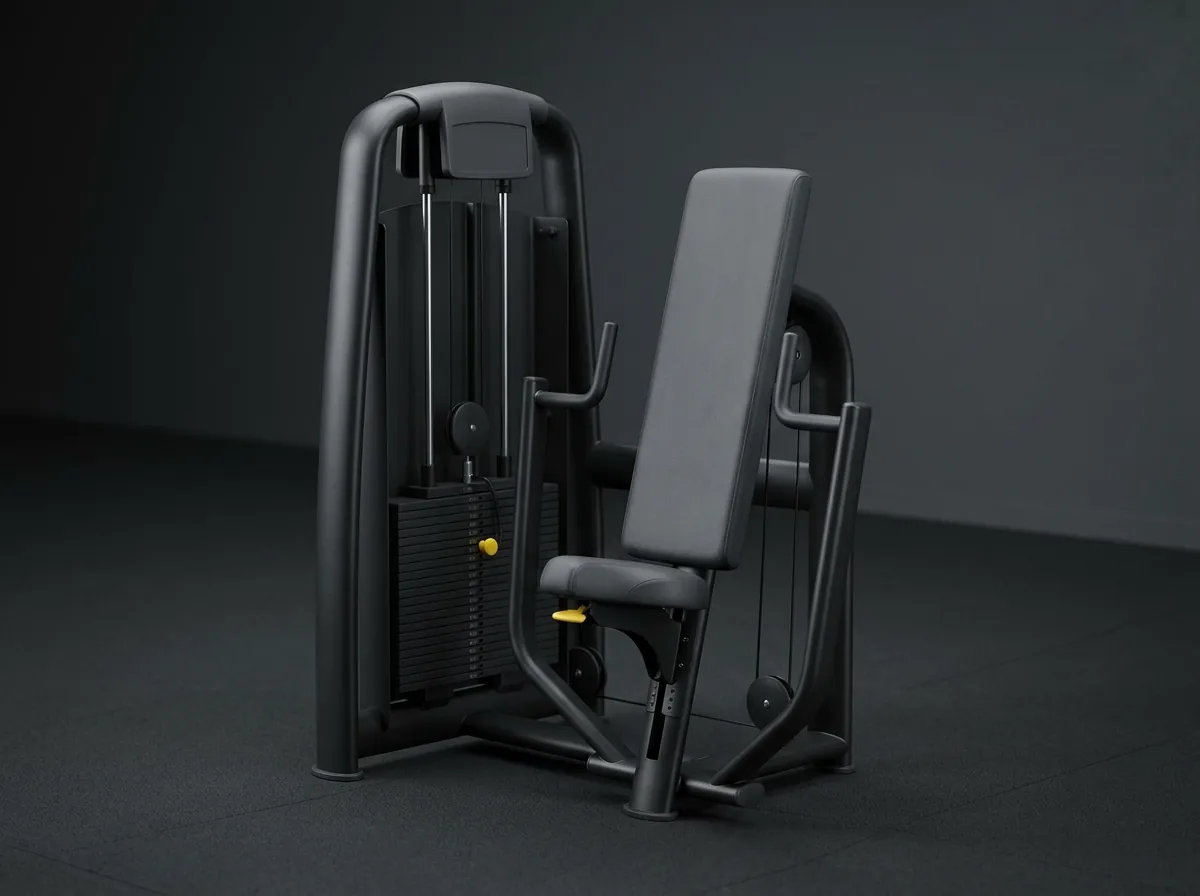
How do you set up the tricep press in 20 seconds?
- 1. Adjust the Seat Height So Handles Start at Mid-Torso Level Pull the seat height pin and adjust the cushion so that when you sit upright and grasp the handles, your elbows bend to roughly a 90-degree angle alongside your ribs without pushing your shoulders up into your ears.
- 2. Rotate the Handles to the Narrow or Wide Position Most tricep press levers feature rotating dual-width grips. Rotate the handles inward to the narrow setting (just outside your hips) to maximize pure triceps isolation, or outward only if you have broader shoulders.
- 3. Select Your Starting Weight and Fasten the Seatbelt Insert the selector pin at 55 lbs for men or 35 lbs for women. Buckle the lap belt snugly across your hips so pushing downward against the handles cannot lift your glutes off the seat pad.
- 4. Pin Your Back to the Pad and Tuck Your Elbows In Sit tall with your upper back pressed against the backrest (or lean slightly forward by 10 degrees only if the machine has no backrest). Draw your elbows tightly against your ribcage so your forearms point straight down toward the handles.
- 5. Seat the Handles Across the Heel of Your Palms Place the base of your palms directly on top of the rubber grips with your wrists firm and neutral, rather than letting the handles bend your hands backward.
Log your seat height number and handle width setting (narrow vs. wide) in Gym.Coach for consistent weekly tracking.
Execution: tempo, breathing, range of motion
- Concentric Phase: 1 Second Press Down (Exhale) Exhale forcefully and press the handles straight down toward your thighs over 1 smooth second until your elbows reach full extension. Keep your shoulders depressed down away from your ears as you push.
- Isometric Peak Contraction: 1 Second Tricep Squeeze Hold the bottom locked-out position for 1 full second, squeezing the backs of your upper arms hard while keeping your elbows tucked close to your sides.
- Eccentric Return Phase: 3 Seconds Controlled Rise (Inhale) Inhale steadily through your nose and allow the handles to rise over a strict 3-second count until your elbows reach a clean 90-degree angle beside your ribs. Stop before your shoulders shrug upward and 1 centimeter before the weight plates touch.
Perform 3 working sets of 8 to 12 repetitions with a 90-second rest interval between sets. (1-1-3 tempo / 90s).
The 5 mistakes you see every day on the tricep press
- 1. Letting the Shoulders Shrug Up Into the Ears at the Top Allowing the handles to push your elbows above 90 degrees until your shoulders touch your earlobes dumps anterior shear stress onto the glenohumeral capsule and acromioclavicular (AC) joint. Stop the return as soon as your forearms are horizontal.
- 2. Flaring the Elbows Out Wide Like Chicken Wings Pointing your elbows out to the sides shifts the press onto the chest and anterior deltoids while twisting the elbow joint. Keep your elbows grazing the sides of your shirt.
- 3. Leaning Your Whole Upper Body Over the Handles Standing up or throwing your chest over the grips uses body weight to push the levers down instead of extending your elbows. Stay seated upright against the backrest with the seatbelt fastened.
- 4. Stopping Short of Full Elbow Extension Cutting the bottom 15 degrees of the press short leaves the medial head and lateral head of the triceps under-stimulated at peak contraction. Straighten your arms completely on every rep.
- 5. Bending the Wrists Backward Under Load Pressing through your fingers with bent wrists strains the carpal tunnel and forearm flexors. Push straight down through the heel of your palm.
Which starting weight should you choose and how do you progress?
Because the seated tricep press leverages all three heads of the triceps in a mechanically strong downward vector, beginners at Planet Fitness or Crunch Fitness can start comfortably at 55 lbs (men) or 35 lbs (women). Use double progression: once you hit 3 sets of 12 full lockouts with a 1-second bottom squeeze and a 3-second eccentric return, increase the load by 5 lbs or 10 lbs. Over 12 weeks, average lifters reach 85-100 lbs (men) and 55-65 lbs (women).
Double Progression Table (US Imperial LBS):
| Session | Sets x Reps (1-1-3 Tempo) | Weight (LBS) |
|---|---|---|
| Session 1 | 3x10 | 55 lbs (F: 35 lbs) |
| Session 2 | 3x11 | 55 lbs (F: 35 lbs) |
| Session 3 | 3x12 | 55 lbs (F: 35 lbs) |
| Session 4 | 3x10 | 60 lbs (+5 lbs step) |
Always buckle the lap belt once the stack weight approaches or exceeds half of your body weight.
How does the tricep press differ by brand?
| Machine Brand & Series | Seat, Belt & Grip Features | Mechanical Path & Practical Note |
|---|---|---|
| Matrix Ultra / Versa Triceps Press (common in Planet Fitness and Anytime Fitness) | Ratcheting seat post, retractable lap seatbelt, and rotating dual-width overhand handles. | Backrest tilts slightly forward by 12 degrees to place your shoulders directly over the handles automatically. |
| Technogym Selection Pro / Artis Arm Extension (common in Anytime Fitness and LA Fitness) | Yellow seat height lever with an angled preacher-style or overhead-pivot extension arm. | Some Technogym clubs use the Seated Dip variant while others use the Preacher Arm Extension; match your elbow to the red/yellow pivot dot. |
| Life Fitness Insignia / Signature / Insignia Seated Dip (common in Crunch Fitness and LA Fitness) | Pull-pin seat post, flip-handle width adjustment, and heavy-duty lap restraint belt. | Can be performed facing forward against the backrest or facing the pad for variation; stick to facing forward for standard tracking. |
| Gym80 Sygnum & Hammer Strength Select (24 Hour Fitness, Crunch, performance clubs) | Heavy-duty steel ratcheting seat pin with laser-etched position numbers | Direct mechanical cam profile; use the +5 lbs drop-down add-on weight when stepping up after 3x12. |
Frequently asked questions
Is the seated tricep press better than a rope tricep pushdown?
Both are excellent and complement each other. The seated tricep press allows you to stabilize your torso with a backrest and seatbelt, letting you overload the lateral and medial heads with heavier weights than you can hold standing in front of a cable stack.
Should I use the narrow grip or wide grip setting on the handles?
Use the narrow grip setting whenever your torso fits comfortably between the arms. Narrower handles keep your elbows tucked naturally against your ribs and focus the load onto the triceps rather than the outer chest.
Why does the front of my shoulder hurt on the tricep dip machine?
Front shoulder pain happens when you let the handles travel too high on the return, forcing your elbows far behind your back and your shoulders up toward your ears. Lower the seat by one notch and stop every return at a strict 90-degree elbow bend.
How does Gym.Coach balance my triceps training across the week?
Gym.Coach supports 95% of commercial gym machines and builds each workout around 5 balanced stations. Because your triceps also work during the chest press and shoulder press, the app manages your total pressing volume so your elbows recover cleanly.