What the lateral raise does and who it is for
The seated lateral raise machine is the premier shoulder-isolation station found in PureGym, The Gym Group, David Lloyd, and Anytime Fitness. While overhead pressing movements heavily recruit the anterior deltoids and triceps brachii, the lateral raise machine isolates the lateral (acromial) head of the deltoid through pure shoulder abduction. Building the lateral deltoid is what creates broader shoulder width, a stronger V-taper silhouette, and balanced glenohumeral joint stability.
When lifters perform standing dumbbell lateral raises, gravity provides almost zero resistance during the bottom 30 degrees of the movement and peaks abruptly at horizontal lockout, tempting people to swing their hips and shrug their upper traps. On a selectorized lateral raise machine, the overhead mechanical cam supplies smooth, continuous torque from the very first inch of abduction while placing the load pads directly against your distal upper arms (elbows) rather than straining your wrists.
In Gym.Coach, which supports 95% of commercial strength equipment across major and boutique brands and selects 5 smartly chosen machines every workout to keep your entire body balanced, the lateral raise machine delivers targeted medial deltoid hypertrophy in three time-efficient sets.
Across United Kingdom clubs including PureGym, The Gym Group, David Lloyd, Nuffield Health, and JD Gyms, you will encounter this station from brands like Matrix, Technogym, Life Fitness, and Gym80. Our UK programme uses colour-coded seat numbers so you can customise your setup in seconds, align your joint centre with the cam pivot, and recruit maximum muscle fibres while optimising recovery with +2.5 kg micro-weight steps (starting at 15 kg for men and 10 kg for women).
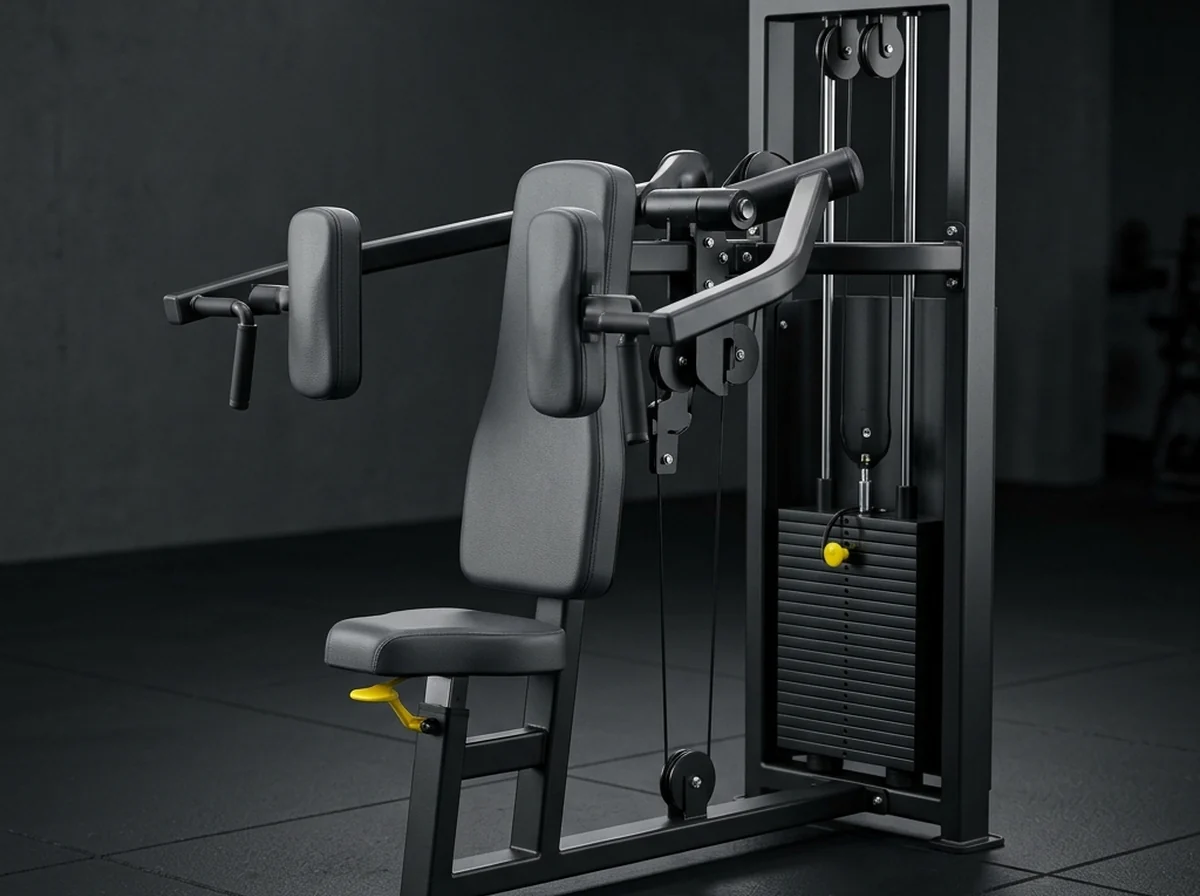
How do you set up the lateral raise in 20 seconds?
- 1. Align Your Shoulder Joints with the Overhead Cam Pivot Axis Pull the yellow or orange seat lever and adjust the seat height until the top outer tip of your shoulder (the acromion process) sits directly in line with the mechanical pivot axis of the rotating lever arms. Proper pivot alignment stops the arm pads from sliding up and down your sleeves.
- 2. Brace Your Chest or Back Against the Support Pad Depending on the machine design, sit facing the padded torso support (chest-supported style) or sit with your back pressed firmly against the upright backrest. Keep your ribcage stacked over your pelvis.
- 3. Seat Your Outer Elbows Squarely Against the Roller Pads Bend your elbows to a 90-degree angle and place the outer sides of your distal upper arms (just above the elbow joint) flush against the padded bolsters. Your forearms should rest comfortably parallel to the handles.
- 4. Depress Your Scapulae Away from Your Ears Before lifting the weight stack, actively draw your shoulder blades down toward your back pockets so your neck looks long and your upper trapezius stays relaxed.
- 5. Select Your Starting Pin and Lightly Hold the Grips Insert the selector pin at 15 kg for men or 10 kg for women. Hold the front handles with a relaxed, light grip so you initiate the lift by driving your elbows outward rather than cranking with your wrists.
Save your exact seat height number in Gym.Coach so your shoulder joint aligns with the cam pivot in seconds.
Execution: tempo, breathing, range of motion
- Concentric Phase: 1 Second Abduction (Exhale) Exhale through your mouth and drive both elbows outward and upward against the pads in a smooth 1-second arc until your upper arms are parallel to the floor (90 degrees of shoulder abduction, right at shoulder height). Think about pushing the side walls away with your elbows.
- Isometric Peak Contraction: 1 Second Hold at Horizontal Pause at shoulder height for 1 full second with your elbows level with your wrists and your neck completely relaxed. Avoid shrugging your shoulders toward your ears at the top.
- Eccentric Lowering Phase: 3 Seconds Lowering (Inhale) Inhale steadily through your nose while lowering your elbows back toward your ribcage over a strict 3-second count. Reverse the repetition 1 centimetre before the moving weight plate touches the stack to keep continuous tension on the lateral deltoids.
Perform 3 working sets of 10 to 12 controlled repetitions with a 1-1-3 tempo and 90 seconds of rest between sets.
The 5 mistakes you see every day on the lateral raise
- 1. Shrugging the Shoulders Up Into the Ears Elevating the scapulae at the start of each rep lets the upper trapezius hijack the load from the lateral deltoids and causes neck stiffness. Depress your shoulder blades before lifting and keep them down throughout the set.
- 2. Raising the Elbows High Above Shoulder Level Driving the arms past 90 degrees of horizontal abduction shifts mechanical work onto the upper traps and narrows the subacromial space. Stop right when your upper arms are parallel to the floor.
- 3. Pulling Upward with the Hands Instead of Leading with the Elbows Cranking the handles upward so your hands finish higher than your elbows externally rotates the humerus and shifts tension to the front deltoids. Keep your elbows level with or slightly higher than your wrists.
- 4. Sitting Too Low Relative to the Machine Pivot When the seat is set too low, the machine axis sits above your shoulder sockets, forcing your shoulders to shrug just to stay in contact with the pads. Raise the seat until your shoulder joints match the pivot markers.
- 5. Using Excessive Weight and Dropping the Eccentric Phase The lateral deltoid is a small, multipennate muscle that responds to strict tension rather than heavy momentum. Drop the pin by one plate and master the 1-second pause at the top and 3-second lowering phase.
Which starting weight should you choose and how do you progress?
Because the lateral deltoid is a precision isolation muscle group, beginners at PureGym or The Gym Group should start at 15 kg (men) or 10 kg (women). Follow double progression: keep the weight fixed until you complete 3 sets of 12 repetitions with a 1-second hold at shoulder height and a 3-second lowering phase, then add 2.5 kg. Over 12 weeks, average lifters progress to 22.5-30 kg (men) and 15-20 kg (women).
Double Progression Table (UK Metric KG):
| Session | Sets x Reps (1-1-3 Tempo) | Weight (KG) |
|---|---|---|
| Session 1 | 3x10 | 15 kg (F: 10 kg) |
| Session 2 | 3x11 | 15 kg (F: 10 kg) |
| Session 3 | 3x12 | 15 kg (F: 10 kg) |
| Session 4 | 3x10 | 17.5 kg (+2.5 kg step) |
Always use the 1.25 kg or 2.5 kg add-on plate when moving up on the lateral raise machine so you never sacrifice your 1-second top hold.
How does the lateral raise differ by brand?
| Machine Brand & Series | Seat & Pad Mechanism | Biomechanical Arc & Practical Note |
|---|---|---|
| Matrix Ultra / Versa Lateral Raise (common in PureGym and David Lloyd) | Numbered ratcheting seat post with upright backrest and pivoting forearm/elbow bolsters. | Align your acromion with the yellow pivot circle on the overhead frame and push outward through the outer elbow pads. |
| Technogym Selection Pro / Artis Delts Machine (common in David Lloyd and Anytime Fitness) | Visual yellow seat lever with independent bilateral lever arms and self-aligning handles. | Independent arms allow you to train both shoulders together or perform single-arm sets to fix side-to-side imbalances. |
| Life Fitness Insignia / Signature / Insignia Lateral Raise (common in The Gym Group and Anytime Fitness) | Forward-facing chest support pad that angles your torso slightly forward into the scapular plane. | Facing the pad naturally positions your elbows 15 to 20 degrees forward in the scapular plane for optimal joint comfort. |
| Gym80 Sygnum (JD Gyms, PureGym strength zones, independent UK clubs) | Heavy-duty steel ratcheting seat pin with laser-etched position numbers | Direct mechanical cam profile; use the +2.5 kg add-on micro-weight plate when stepping up after 3x12. |
Frequently asked questions
Why do I feel the lateral raise machine in my neck and upper traps instead of the side of my shoulders?
Neck and trap fatigue happens when you shrug your shoulders upward at the start of the rep or lift your elbows past 90 degrees of shoulder height. Lower your seat by one notch if your shoulders are above the pivot point, depress your shoulder blades down before initiating the movement, and stop right when your elbows reach horizontal.
Is the seated lateral raise machine better than dumbbell lateral raises for shoulder width?
Both build the medial deltoids effectively, but the machine provides continuous cam resistance during the bottom 30 degrees of abduction (where dumbbells provide near-zero tension) and removes grip and wrist fatigue so you can take the lateral deltoids closer to true muscular failure.
Should I sit facing the pad or with my back against the pad?
Always follow the orientation designed by the manufacturer on that specific station. Life Fitness Lateral Raise machines are engineered for you to sit facing the chest pad, whereas most Matrix and Technogym models are built with an upright backrest.
How does Gym.Coach schedule the lateral raise machine in my 30-minute workouts?
Gym.Coach supports 95% of commercial gym machines across major and boutique brands and selects 5 smartly chosen stations every workout. It pairs the lateral raise with compound upper-body pushes and pulls to ensure complete three-dimensional shoulder development.