What the pec fly does and who it is for
The seated pec fly machine (often called the pec deck or dual pec fly / rear delt station) is the premier single-joint chest isolation machine in PureGym, The Gym Group, David Lloyd, and Anytime Fitness. During a dumbbell fly on a flat bench, gravity pulls straight down toward the floor, meaning resistance drops to nearly zero at the top of the rep when your hands meet above your chest. On the seated pec fly machine, overhead rotary cams maintain constant horizontal resistance from the opening stretch all the way to the final millimetre where your hands meet in front of your sternum.
Mechanically, the exercise isolates pure horizontal adduction of the shoulder joint without requiring the triceps brachii to extend the elbows. Because the triceps cannot fatigue early and limit the set, you can fully exhaust the sternal fibres of the pectoralis major with complete shoulder safety.
In Gym.Coach, which supports 95% of commercial strength equipment across major and boutique brands and selects 5 smartly coordinated machines every session, the pec fly serves as the dedicated chest isolation station to complement compound pressing.
Across United Kingdom clubs including PureGym, The Gym Group, David Lloyd, Nuffield Health, and JD Gyms, you will encounter this station from brands like Matrix, Technogym, Life Fitness, and Gym80. Our UK programme uses colour-coded seat numbers so you can customise your setup in seconds, align your joint centre with the cam pivot, and recruit maximum muscle fibres while optimising recovery with +2.5 kg micro-weight steps (starting at 20 kg for men and 12.5 kg for women).
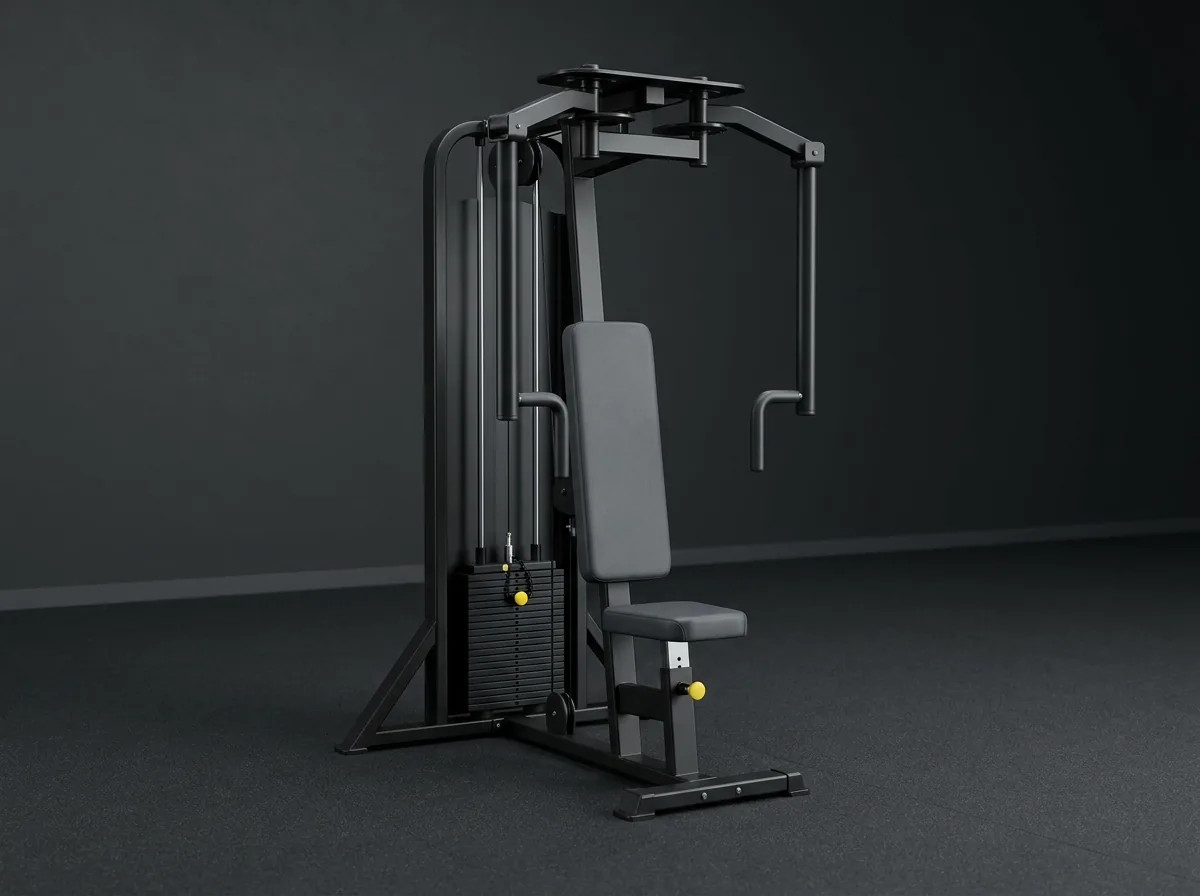
How do you set up the pec fly in 20 seconds?
- 1. Set the Overhead Cam Arms to the Front Pec Fly Position Pull the overhead spring pins on both swing arms and lock them into the forward-facing chest fly holes so the handles start slightly behind or directly in line with the plane of your torso (roughly settings 2 or 3 on most dual machines).
- 2. Adjust the Seat Height So Handles Align with Your Mid-Chest Sit on the saddle and adjust the vertical seat height until when you grasp the vertical handles, your elbows, wrists, and hands sit slightly below shoulder level, right in line with your mid-sternum.
- 3. Select Your Starting Weight on the Stack Insert the selector pin at 20 kg for men or 12.5 kg for women. Because your extended arms create a long lever arm at the shoulder joint, lighter weights feel substantially heavier than on a chest press.
- 4. Bring One Arm Forward at a Time and Pin Your Scapulae Place your feet flat on the floor, press your upper back against the pad, and bring the handles forward into position one arm at a time (or use the foot lever if equipped) rather than reaching far behind your back with both arms simultaneously.
- 5. Maintain a Fixed 10 to 15-Degree Soft Bend in Your Elbows Set a slight, comfortable bend in your elbows as if wrapping your arms around the trunk of a wide oak tree, with your elbows pointed horizontally outward rather than drooping toward the floor.
Write down your seat height number and overhead cam hole number in Gym.Coach so your shoulder stretch depth stays safe.
Execution: tempo, breathing, range of motion
- Concentric Phase: 1 Second Arc Sweep (Exhale) Exhale forcefully and sweep both arms together in a wide horizontal arc over 1 smooth second until the handles lightly touch (or come within 2 centimetres of touching) directly in front of your sternum. Keep your elbow angle frozen throughout the sweep.
- Isometric Peak Contraction: 1 Second Inner-Chest Squeeze Hold the closed midline position for 1 full second, focusing on driving the insides of your elbows and biceps toward each other while keeping the backs of your shoulders pressed into the pad.
- Eccentric Return Phase: 3 Seconds Controlled Opening (Inhale) Inhale steadily through your nose while allowing the arms to open outward over a strict 3-second count until your elbows reach the plane of your torso and you feel a deep stretch across your chest. Reverse the movement 1 centimetre before the weight plates touch.
Perform 3 working sets of 10 to 12 repetitions with a 90-second rest interval between sets. (1-1-3 tempo / 90s).
The 5 mistakes you see every day on the pec fly
- 1. Setting the Cam Arms Too Far Behind the Torso Starting the fly with your hands pulled 30 degrees behind your back hyperextends the anterior glenohumeral capsule and places excessive strain on the biceps tendon. Set the cam pins so your elbows stop in line with your back.
- 2. Bending the Elbows and Turning the Fly Into a Press Flexing your elbows to 90 degrees on the way back and pushing the handles together shortens the lever arm to cheat a weight that is too heavy. Keep your elbows locked at a constant soft 15-degree bend.
- 3. Hunching the Shoulders Forward as the Hands Meet Rounding your upper back off the pad to touch the handles shifts tension onto the anterior deltoids and pectoralis minor. Keep your breastbone lifted toward the ceiling as your hands come together.
- 4. Clanking the Metal Handle Brackets Together at the Front Smashing the handles together at the centre relies on momentum and bounces the arms apart. Bring the handles to a whisper-quiet kiss at the midline and hold for 1 full second.
- 5. Dropping the Elbows Below the Wrists Letting your elbows sag downward while your hands stay high internally rotates the shoulder under load. Keep your wrists, forearms, and elbows in one flat horizontal plane.
Which starting weight should you choose and how do you progress?
Because the pec fly uses a long moment arm across a single joint, beginners at PureGym or The Gym Group should start at 20 kg (men) or 12.5 kg (women). Use double progression: add 2.5 kg (or use the 1.25 kg or 2.5 kg add-on plate) only after completing 3 sets of 12 reps with a full 1-second midline hold and a 3-second eccentric return. Over 12 weeks, average lifters progress to 32.5-40 kg (men) and 20-27.5 kg (women).
Double Progression Table (UK Metric KG):
| Session | Sets x Reps (1-1-3 Tempo) | Weight (KG) |
|---|---|---|
| Session 1 | 3x10 | 20 kg (F: 12.5 kg) |
| Session 2 | 3x11 | 20 kg (F: 12.5 kg) |
| Session 3 | 3x12 | 20 kg (F: 12.5 kg) |
| Session 4 | 3x10 | 22.5 kg (+2.5 kg step) |
Never sacrifice the 1-second isometric touch at the front just to move the pin down another plate.
How does the pec fly differ by brand?
| Machine Brand & Series | Arm Cam & Seat Adjustments | Handle Design & Practical Note |
|---|---|---|
| Matrix Ultra / Versa Dual Pec Fly / Rear Delt (common in PureGym and David Lloyd) | Dual overhead indexed cam dials with numbered holes for chest fly vs. rear deltoid reverse fly. | Self-pivoting vertical handles automatically adjust to your forearm length throughout the sweeping arc. |
| Technogym Selection Pro / Artis Pectoral (common in David Lloyd and Anytime Fitness) | Yellow seat height lever paired with ergonomic forearm-and-grip pads or extended vertical swing arms. | Wait until you are seated to push the forearms inward; the independent arms allow unilateral concentration work. |
| Life Fitness Insignia / Signature / Insignia Fly / Rear Delt (common in The Gym Group and Anytime Fitness) | Overhead pull-pin range dials with 5 chest-fly starting angles and a ratcheting seat post. | Long curved vertical handles let you fine-tune hand height without changing the seat notch. |
| Gym80 Sygnum (JD Gyms, PureGym strength zones, independent UK clubs) | Heavy-duty steel ratcheting seat pin with laser-etched position numbers | Direct mechanical cam profile; use the +2.5 kg add-on micro-weight plate when stepping up after 3x12. |
Frequently asked questions
What is the difference between a straight-arm fly handle machine and a bent-arm forearm-pad butterfly machine?
Both isolate horizontal adduction of the chest. Straight-arm handle machines (the modern Dual Pec Fly) allow your hands to rotate neutrally and are generally easier on the shoulder capsule, whereas classic 90-degree bent-arm forearm pads place the humerus in stronger internal rotation.
Can the pec fly specifically build my inner chest?
While you cannot contract only the inner portion of a single muscle fibre, the pec fly creates maximum resistance at full horizontal adduction where the sternal fibres near your breastbone shorten completely. Over time, thickening the entire sternal head makes the inner-chest cleavage much more defined.
How far back should I let the handles go on the stretch?
Stop when your upper arms and elbows are roughly in line with the plane of your back (or just 10 degrees behind it). Going further back places stress on the anterior shoulder capsule rather than stretching the chest.
How does Gym.Coach use the dual pec fly machine?
Gym.Coach supports 95% of commercial strength equipment across major and independent brands and selects 5 smartly coordinated stations each workout. It tracks your exact weight and cam setting so you can progress your chest isolation safely week after week.