What the shoulder press does and who it is for
The seated overhead shoulder press machine is the primary vertical pushing station found in PureGym, The Gym Group, David Lloyd, and Anytime Fitness. Pressing dumbbells or a barbell overhead requires continuous 360-degree stabilization from the rotator cuff and deep core just to keep the weights from drifting behind your head. The seated shoulder press machine guides the handles along a safe, slightly converging overhead arc while supporting your spine against a high backrest.
Mechanically, the machine combines shoulder abduction and shoulder flexion with elbow extension. This builds broad, rounded lateral and anterior deltoids while strengthening the triceps brachii and serratus anterior for overhead reaching tasks in daily life.
In Gym.Coach, which covers 95% of commercial gym machines across major and independent brands and selects 5 smartly coordinated stations every workout, the shoulder press provides the essential vertical push to complement the lat pulldown.
Across United Kingdom clubs including PureGym, The Gym Group, David Lloyd, Nuffield Health, and JD Gyms, you will encounter this station from brands like Matrix, Technogym, Life Fitness, and Gym80. Our UK programme uses colour-coded seat numbers so you can customise your setup in seconds, align your joint centre with the cam pivot, and recruit maximum muscle fibres while optimising recovery with +2.5 kg micro-weight steps (starting at 15 kg for men and 10 kg for women).
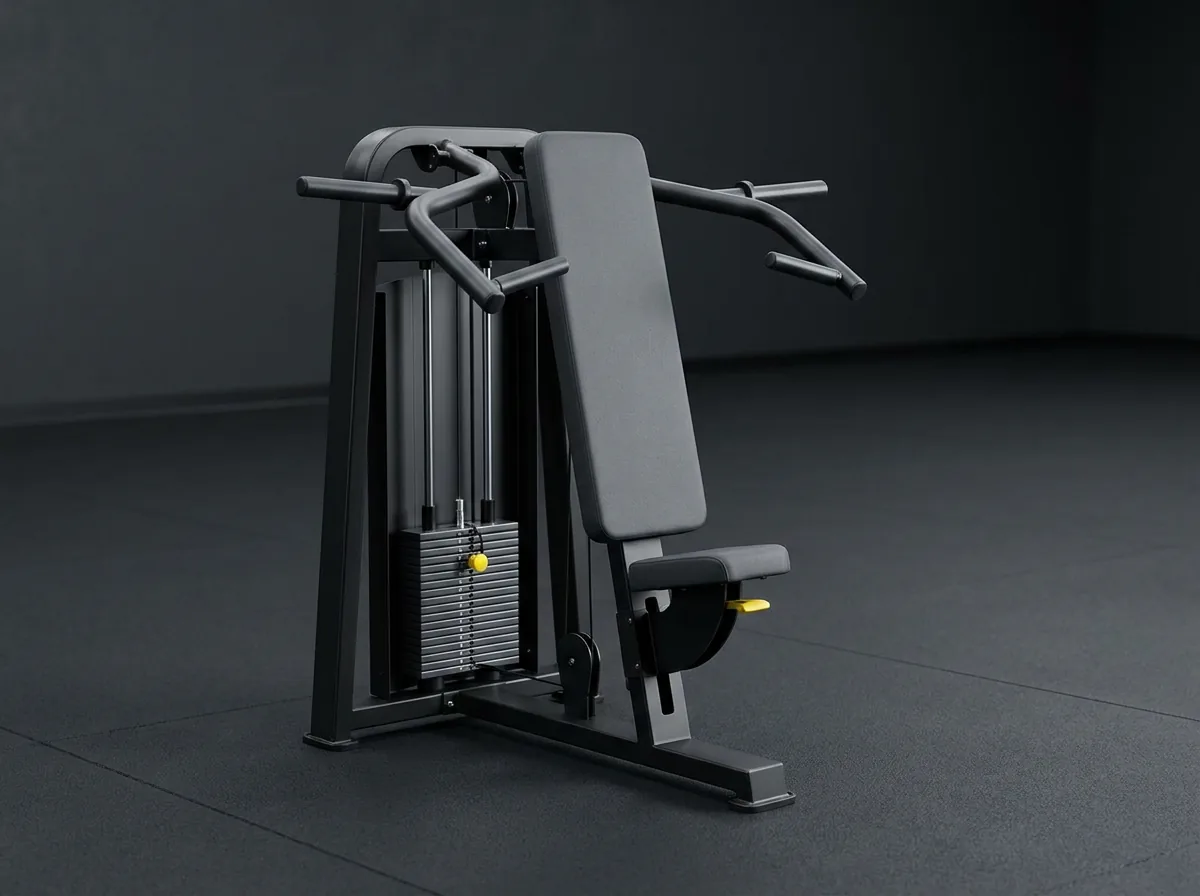
How do you set up the shoulder press in 20 seconds?
- 1. Adjust the Seat Height So Handles Start at Ear-to-Chin Level Pull the seat adjustment lever and set the cushion height so that when you sit tall, the handles sit right at the level of your chin, jawline, or earlobes. Never set the seat so high that the handles start below your collarbones, as that forces excessive internal rotation at the bottom.
- 2. Select Your Starting Weight on the Stack Insert the selector pin at 15 kg for men or 10 kg for women. Because the deltoids have a smaller physiological cross-sectional area than the chest or back, starting conservatively is essential for clean overhead mechanics.
- 3. Choose Between Neutral (Scapular Plane) or Pronated Handles Most machines provide both wide horizontal handles and forward-angled neutral handles. Beginners and anyone with sensitive shoulders should use the forward-angled neutral handles, which position the elbows 30 degrees forward in the natural scapular plane.
- 4. Plant Your Feet and Anchor Your Lower Back to the Pad Place both feet flat on the floor slightly wider than hip-width. Brace your abdominal wall to draw your lower ribs down so your lumbar and thoracic spine stay in firm contact with the backrest.
- 5. Stack Your Wrists Directly Over Your Elbows Grip the handles firmly and verify in the mirror that your forearms are completely vertical from both the front and side views, with your elbows positioned directly underneath your wrists.
Save your seat height setting and preferred handle choice in Gym.Coach so your shoulder joints track identically every session.
Execution: tempo, breathing, range of motion
- Concentric Phase: 1 Second Overhead Press (Exhale) Exhale forcefully and press the handles smoothly upward over 1 second until your arms are extended overhead with a soft micro-bend remaining at the elbows. Keep your head resting lightly against the headrest rather than jutting your chin forward.
- Isometric Peak Hold: 1 Second Control Hold the top overhead position for 1 full second with your biceps framed near your ears and your ribcage braced down.
- Eccentric Lowering Phase: 3 Seconds Lowering (Inhale) Inhale steadily through your nose while lowering the handles under strict control over a 3-second count until the grips return to chin or ear height. Reverse the movement 1 centimetre before the moving plate touches the weight stack.
Complete 3 working sets of 8 to 12 controlled repetitions, resting 90 seconds between sets. (1-1-3 tempo / 90s).
The 5 mistakes you see every day on the shoulder press
- 1. Setting the Seat Too High (Starting Below the Shoulders) When the seat is too high, the handles begin down near your armpits, jamming the greater tubercle of the humerus against the acromion at the start of every rep. Lower the seat until the handles start at jaw or ear height.
- 2. Arching the Lower Back to Turn It Into an Incline Chest Press Sliding your hips forward and arching your thoracic and lumbar spine recruits the upper chest to bail out fatigued deltoids while compressing your lower vertebrae. Keep your tailbone and ribs anchored to the pad.
- 3. Flaring Elbows Straight Out Behind the Body Pressing with your elbows pulled behind the line of your ears strains the anterior shoulder capsule. Keep your elbows slightly in front of your torso (about 30 degrees forward of the frontal plane).
- 4. Bouncing Out of the Bottom of the Repetition Dropping the handles quickly and bouncing off the bottom of the shoulder joint places sudden tensile stress on the rotator cuff tendons. Honour the full 3-second eccentric tempo on every rep.
- 5. Jutting the Head Forward Under Strain Poking your chin forward during hard reps tightens the levator scapulae and upper traps. Keep the back of your skull lightly touching the upholstery.
Which starting weight should you choose and how do you progress?
Because overhead pressing relies on smaller deltoid and triceps muscle bellies, beginners at PureGym or The Gym Group should start at 15 kg (men) or 10 kg (women). Use double progression: add 2.5 kg (or engage the 1.25 kg or 2.5 kg add-on plate) only after completing 3 sets of 12 reps with a 3-second lowering phase and zero back arch. Over 12 weeks, average lifters reach 25-32.5 kg (men) and 17.5-22.5 kg (women).
Double Progression Table (UK Metric KG):
| Session | Sets x Reps (1-1-3 Tempo) | Weight (KG) |
|---|---|---|
| Session 1 | 3x10 | 15 kg (F: 10 kg) |
| Session 2 | 3x11 | 15 kg (F: 10 kg) |
| Session 3 | 3x12 | 15 kg (F: 10 kg) |
| Session 4 | 3x10 | 17.5 kg (+2.5 kg step) |
Always use the 1.25 kg or 2.5 kg add-on plate on shoulder presses; jumping a full plate too early is the fastest way to stall overhead progress.
How does the shoulder press differ by brand?
| Machine Brand & Series | Seat & Handle Geometry | Biomechanical Arc & Practical Note |
|---|---|---|
| Matrix Ultra / Versa Series (common in PureGym and David Lloyd) | Ratcheting seat column with wide pronated and forward-angled neutral multi-grips. | Converging independent arms angle slightly inward at the top to prevent bone-on-bone acromial impingement. |
| Technogym Selection Pro / Artis (common in David Lloyd and Anytime Fitness) | Spring-balanced yellow seat lever plus counterbalanced pressing arms for lower starting resistance. | Ergonomic backrest tilts backward by 15 degrees so the press naturally tracks in the scapular plane. |
| Life Fitness Insignia / Signature / Insignia Series (common in The Gym Group and Anytime Fitness) | Pull-pin numbered seat post with oversized dual-position rubberized handles. | Counterbalanced arms reduce the unweighted starting resistance, making it ideal for rehabilitation and smaller lifters. |
| Gym80 Sygnum (JD Gyms, PureGym strength zones, independent UK clubs) | Heavy-duty steel ratcheting seat pin with laser-etched position numbers | Direct mechanical cam profile; use the +2.5 kg add-on micro-weight plate when stepping up after 3x12. |
Frequently asked questions
Which handles are safer for my rotator cuff: wide or neutral?
The forward-angled neutral handles (palms facing each other) are significantly gentler on the rotator cuff because they place your upper arms in the 30-degree scapular plane and externally rotate the humerus, creating maximum clearance under the acromion.
Why does the shoulder press progress more slowly in weight than the chest press?
The anterior and lateral deltoids are smaller muscles working across a longer lever arm against gravity. A 2.5 kg (5 lbs) increase on a shoulder press represents a much larger percentage jump than the same increase on a leg press or chest press.
How low should I lower the handles on each repetition?
Lower the handles until they reach chin, jaw, or earlobe height. Going lower than your chin forces the humerus into end-range internal rotation under load and provides no extra deltoid recruitment.
How does Gym.Coach incorporate the shoulder press into my workouts?
Gym.Coach supports 95% of commercial strength machines across major and independent brands and selects 5 balanced stations per session. It pairs the shoulder press with vertical and horizontal pulling movements so your anterior and posterior deltoids develop in harmony.